
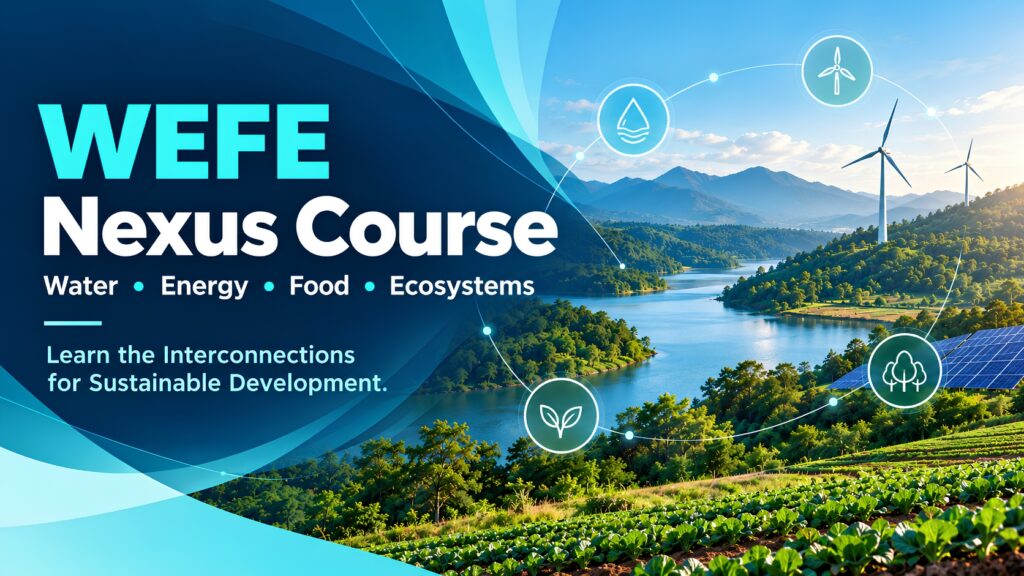
Free WEFE Nexus Online Course 2026
The free Water–Energy–Food–Ecosystems (WEFE) Nexus Global Level Course provides online training in integrated resource management, climate resilience and sustainable development. Open to relevant professionals and stakeholders worldwide, it offers a free certificate after successful completion.
Free WEFE Nexus Online Course 2026 – UNEP-DHI, Cap-Net & GWP-Med | Free Certificate
Quick Overview
| Host Organisations | UNEP-DHI Centre, Cap-Net and Global Water Partnership–Mediterranean (GWP-Med) |
|---|---|
| Host Country | International Programme |
| Location | Online / Worldwide |
| Opportunity Type | Online Training / Professional Development |
| Degree/Academic Level | Introductory Course / Professional Training |
| Funding Status | Fully Free Course and Completion Certificate |
| Duration | 22 Hours (4 Modules) |
| Eligible Applicants | Water, Energy, Food, Environmental and Climate-Related Professionals and Stakeholders Worldwide |
| Application Fee | Free |
| Course Language | English |
| IELTS/English Requirement | No IELTS score specified; learning materials are in English |
| Applications Open | Yes – Listed Among Open Courses |
| Deadline | No Fixed Deadline Specified |
Detailed Description
The Water–Energy–Food–Ecosystems (WEFE) Nexus Global Level Course is a free online training programme developed through collaboration between the UNEP-DHI Centre, Cap-Net and Global Water Partnership–Mediterranean.
The course introduces an integrated approach to managing water, energy, food systems and ecosystems. Rather than considering these sectors independently, the WEFE Nexus examines how decisions affecting one resource can influence the availability, sustainability and management of others.
This approach is particularly important for addressing climate change, water scarcity, environmental degradation, food security and sustainable resource management.
Designed for professionals and stakeholders working across relevant sectors, the course combines theoretical learning with practical examples, case studies and interactive activities.
Participants explore WEFE Nexus frameworks, resource assessments, scenario development, climate change adaptation, stakeholder engagement and integrated decision-making.
The programme draws on case studies from Africa, Asia, Europe, Latin America, the Middle East and Small Island Developing States, helping learners understand how resource-management challenges differ across geographical and socio-economic contexts.
Course Structure
The programme consists of four modules:
Module 1: Introduction to the WEFE Nexus
Introduces the relationship between water, energy, food systems and ecosystems, including the principles and importance of integrated resource management.
Module 2: Scenario Development and Nexus Assessments for Informed Decision-Making
Explores scenario development, resource indicators, data collection and assessment tools used to support planning and decision-making.
Module 3: WEFE Nexus Interlinkages in the Context of Climate Change
Examines climate change impacts, adaptation strategies, mitigation and the relationship between climate resilience and resource security.
Module 4: Operationalizing Nexus Solutions
Focuses on practical responses, stakeholder engagement, financing, governance and monitoring approaches for integrated resource management.
Each module includes introductory videos, reading materials, additional learning resources, discussion forums and assessments.
Eligibility Criteria
The course is intended for participants from diverse stakeholder groups working in relevant sectors worldwide.
Eligible target groups include:
- Water management professionals and stakeholders.
- Professionals working with civil society organisations and river basin organisations.
- Staff and stakeholders from international organisations and development programmes.
- Professionals involved in United Nations organisations and related initiatives.
- Sustainable Development Goals (SDG) focal points and facilitators in national governments.
- Government decision-makers, policymakers and senior managers.
- Energy planners and professionals working in energy-related sectors.
- Agricultural and food-system professionals.
- Environmental and ecosystem management practitioners.
- Climate change adaptation and resilience specialists.
- Capacity development professionals working in water management, governance and climate-related fields.
Build a CV for This Opportunity
Free, no account needed, and downloadable as Word or PDF.
Build my CVBenefits
- Free access to the online WEFE Nexus training programme.
- Free downloadable completion certificate after meeting course requirements.
- Four structured learning modules.
- Approximately 22 hours of learning.
- Introductory knowledge of integrated water, energy, food and ecosystem management.
- Training in scenario development and resource assessments.
- Understanding of climate adaptation and mitigation approaches.
- Exposure to international case studies and practical resource-management challenges.
- Opportunities to exchange experiences through discussion forums.
- Learning materials developed with established international organisations.
- Flexible online study through the Cap-Net Virtual Campus.
Documents Required
The official course description does not publish a mandatory document checklist.
Applicants should follow the registration instructions displayed on the Cap-Net Virtual Campus.
- Online registration through the official learning platform.
- Required account and profile information requested during registration.
- Any additional information specifically requested by the platform.
Application Process
Visit the Official Course Website
Access the WEFE Nexus Global Level Course through the official Cap-Net website and review its learning structure, target audience and certificate requirements.
Select Apply Now
Choose the official Apply Now option, which directs applicants to the Cap-Net Virtual Campus registration system.
Register on the Learning Platform
Create a learner account or follow the available account-access instructions. Complete the registration information requested by the platform.
Access the Course Modules
After gaining access, begin the course and study the introductory videos, mandatory readings and other learning materials.
Complete the Module Assessments
Answer the multiple-choice questions at the end of each module. Participants have up to three attempts to achieve at least 60% correct answers.
Complete the Feedback Survey
After successfully completing all four modules, answer the short course feedback survey.
Download Your Certificate
Eligible participants can download their free completion certificate from the learning platform after satisfying the course requirements.
Selection Criteria
The official course page does not describe a competitive selection process or publish an admissions scoring system.
The following completion conditions are confirmed:
- Participants must complete all four modules.
- A multiple-choice assessment is required at the end of each module.
- Participants must achieve at least 60% correct responses.
- Up to three attempts are permitted for each module quiz.
- A short feedback survey must be completed.
- Certificates become available after successful course completion.
Timeline
- Applications openCurrently listed among Cap-Net's open courses
- Registration deadlineNo fixed deadline specified
- Course formatOnline, self-paced
- Course duration22 hours overall
- Module completionFour modules, including assessments
- Certificate availabilityAfter successful completion of all modules and the feedback survey
Why This Opportunity?
- Gain practical knowledge of the Water–Energy–Food–Ecosystems Nexus.
- Understand connections between natural resources and sustainable development.
- Explore integrated approaches to water, energy and food security.
- Strengthen understanding of climate change adaptation and resilience.
- Learn about resource assessments and evidence-based decision-making.
- Study international case studies from different regions.
- Develop knowledge relevant to environmental planning, sustainability and development.
- Receive a free course completion certificate.
- Learn through an established international water-management training network.
Mindship Global Tips
- Check the correct courseChoose the Global Level WEFE Nexus Course, which targets relevant stakeholders worldwide, rather than the separate Mediterranean-focused version.
- Review the learning objectivesFamiliarise yourself with integrated resource management and sustainability concepts before beginning.
- Plan your study timeAllocate sufficient time for all four modules, including readings, discussions and assessments.
- Understand the assessment rulesEach module requires at least 60% correct answers, with up to three attempts available.
- Engage with case studiesFocus on how integrated resource-management approaches can apply to practical environmental challenges.
- Complete the feedback surveyIt is required before the certificate can be downloaded.
- Check course availabilityAlthough currently listed among open courses, enrolment arrangements may change.
- Use your certificate accuratelyDescribe it as professional development training rather than a university degree or accredited professional licence.
Frequently Asked Questions
Is the WEFE Nexus Global Level Course free?
Yes. The official organiser confirms that participation and downloading the completion certificate are free of charge.
Is a free certificate available?
Yes. Participants can download a free certificate after completing the four modules, passing the required quizzes and submitting the course feedback survey.
Is IELTS required?
The official global course page specifies English as the course language but does not publish a mandatory IELTS score or English-language test requirement.
Can international participants apply?
Yes. The global course targets participants from relevant water, energy, food, environment and climate-related stakeholder groups worldwide.
Can university students enrol?
The course is introductory, but its published target audience focuses on professionals and stakeholders. Students interested in the subject should check any registration conditions on the learning platform.
What is the duration of the course?
The official course page lists 22 hours overall. It also describes approximately four hours of mandatory activities per module, with optional resources requiring additional time.
How many modules are included?
There are four modules covering WEFE concepts, assessments, climate change and practical Nexus solutions.
What score is required to receive the certificate?
Participants must achieve at least 60% correct answers on each module quiz. Up to three attempts are permitted.
Is there an age limit?
The official global course page does not specify a minimum or maximum age.
What is the application deadline?
No fixed application deadline is published. The programme is currently listed among Cap-Net's open online courses.
Official Application Link
Disclaimer
📌 Mindship Global shares verified educational opportunities for informational purposes only. Applicants should verify eligibility, funding arrangements, deadlines, required documents, and application requirements through the official website before applying.
Questions & Comments
No questions yet. If something about this opportunity is unclear, ask - the answer helps whoever reads it next.
Ask a question
Deadlines pass quickly - passing it on is often what gets someone to apply in time.