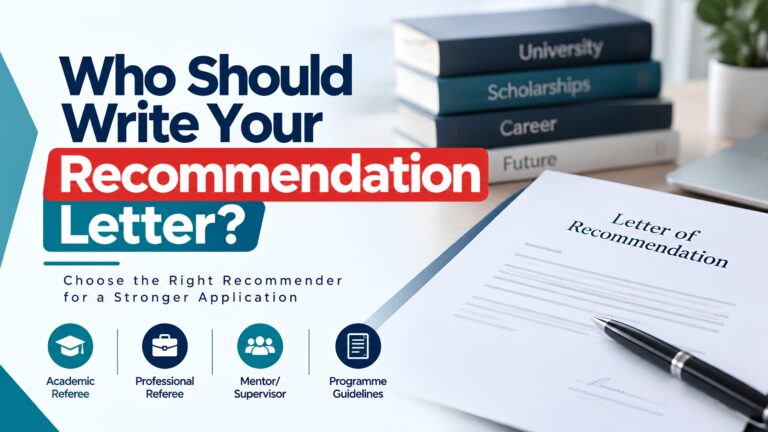
A strong recommendation letter can add something to your application that grades, a CV and a personal statement cannot: an informed assessment of your abilities from someone who has taught, supervised or worked with you.
Whether you are applying for a scholarship, postgraduate degree, fellowship, research opportunity, internship or job, knowing how to ask for a strong recommendation letter matters. The strongest letters usually come from people who know your work well and understand what you are applying for.
Key Takeaways
- Choose someone who knows your work well, not simply the most senior person you know.
- Ask whether they can provide a strong recommendation, rather than assuming they will.
- Give your referee several weeks’ notice whenever possible.
- Provide your CV, programme information, deadline and relevant background together.
- Check the official referee requirements for every application.
Choose the Right Person
Who should you ask?
The right recommender depends on your application. For postgraduate study, a lecturer, research supervisor or academic adviser may be appropriate. For an internship, professional programme or job, a manager or project supervisor may be more relevant.
Oxford University Careers Service recommends choosing referees who can credibly comment on your abilities in an academic or professional capacity and contacting them before listing them. MIT similarly advises graduate applicants to choose people who know their academic work well.
A detailed recommendation from someone who knows you well will often provide more useful evidence than a generic letter from a prestigious person who has had limited contact with you.
Match the referee to your application
Think about what the selection panel needs to understand about you. A research supervisor may discuss your analytical ability, independence and research skills, while an employer may be better placed to describe your communication, leadership and professional reliability.
If several recommendation letters are required, consider choosing referees who can demonstrate different aspects of your profile.
How to Ask for a Strong Recommendation Letter
Ask directly
Do not simply enter somebody’s email address into an application system without speaking to them first.
Explain what you are applying for, why you believe they would be an appropriate referee and ask whether they would be comfortable providing a strong recommendation letter.
Berkeley Career Engagement specifically advises applicants to ask whether a potential recommender is willing to write a strong letter. If someone appears hesitant, it may be better to approach another suitable referee.
A simple request might be:
“I am applying for [programme/opportunity] and wondered whether you would feel comfortable writing me a strong recommendation based on our work together.”
This is polite, clear and gives the person an opportunity to decline.
Ask early
Recommendation letters require time and thought. MIT’s Nuclear Science and Engineering Communication Lab suggests allowing around three to four weeks for many programmes and jobs, while Berkeley recommends approximately four to six weeks for law-school recommendations.
These are guidelines rather than universal rules. Application deadlines and procedures vary, so asking earlier is usually safer.
Give Your Recommender the Right Information
Once your referee agrees, make the process as straightforward as possible.
Useful materials may include:
- your current CV or résumé
- the programme, scholarship, fellowship or job description
- the submission deadline and method
- your personal statement or draft, where relevant
- your academic transcript, where useful
- a brief explanation of your goals and motivation.
MIT’s Communication Lab recommends providing logistical information, your CV, relevant experiences and your reasons for applying. Yale also advises giving references your current résumé, role information and reminders of relevant projects or work you completed together.
You should not dictate what your referee writes. However, you can remind them of experiences they personally observed, such as a research project, dissertation, presentation, internship assignment or leadership responsibility.
Check the Official Recommendation Requirements
Recommendation requirements vary considerably between universities, scholarships, fellowships and employers.
Before approaching your referee, check:
- how many recommendation letters are required
- whether academic or professional referees are preferred
- the submission deadline
- how the recommendation must be submitted
- whether the letter should remain confidential.
For example, MIT Graduate Admissions asks applicants to enter recommender information into its application system, after which the submission request is sent directly to the recommender. Individual departments may have additional requirements.
Never assume the requirements from one application will be the same for another.
Follow Up Professionally
If the deadline is approaching and the recommendation has not yet been submitted, a short and polite reminder is reasonable. Berkeley recommends maintaining appropriate contact with your referee and gently reminding them as the deadline approaches.
Check your application portal first if it provides submission-status information. Avoid repeatedly contacting your referee within a short period.
After submission, send a thank-you message. You can also update them later about the outcome of your application.
Common Mistakes to Avoid
Avoid choosing someone purely because of their title, approaching them at the last minute or failing to explain what you are applying for.
Do not pressure a hesitant referee. Never alter a recommendation letter or submit it yourself where the programme requires confidential submission directly from the recommender.
Conclusion
Learning how to ask for a strong recommendation letter comes down to three things: choosing the right person, respecting their time and giving them enough information to write meaningfully about you.
Start early, read the official application instructions and choose someone who can support their assessment with real examples. A strong recommendation cannot guarantee admission, funding or selection, but it can provide valuable independent evidence of your abilities and potential.
FAQs
How far in advance should I ask for a recommendation letter?
Several university career services recommend allowing at least several weeks. Around four weeks is a useful general starting point, although busy academic periods or complex applications may require more time.
Should I send my personal statement to my referee?
Often, yes. A personal statement can help your referee understand your goals, motivation and how their recommendation fits your wider application.
Can I use the same referee for several applications?
Often, yes, provided they agree and each programme accepts that type of referee. Give them the correct programme information and deadline for every application.
Mindship Global Tip
Create a simple recommender pack containing your CV, programme link, deadline, submission instructions and two or three relevant experiences the referee personally knows about. It saves them time and can help them write a more specific letter.
Disclaimer
Mindship Global shares verified educational opportunities for informational purposes only. Always verify eligibility, funding, deadlines, required documents and application requirements through the official programme website before applying.