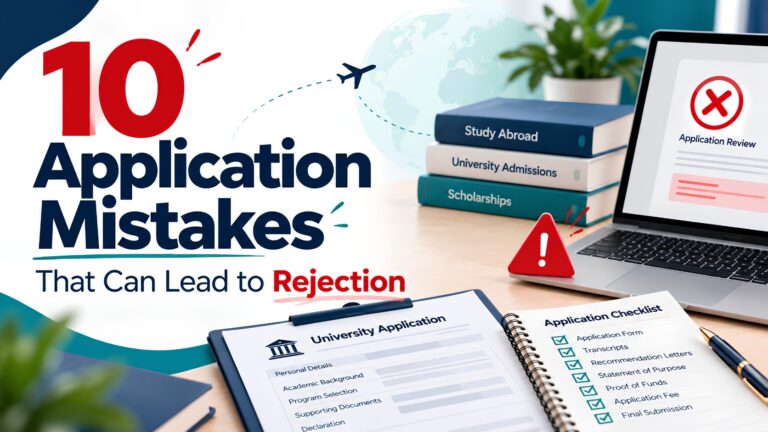
Scholarship applications often involve much more than completing an online form. You may need academic records, references, personal statements, proof of identity and programme-specific documents — sometimes from several different people or institutions.
A practical scholarship application checklist can help you prepare these materials before deadlines become stressful. The exact requirements vary between scholarships, universities, countries and study levels, so the most important rule is to treat the official scholarship page as your final source of information.
Preparing early will not guarantee selection, but it can reduce avoidable mistakes and give you more time to produce a complete, accurate application.
Key Takeaways
- Check eligibility before spending time preparing an application.
- Record the official deadline, including its time zone.
- Prepare academic documents and identification early.
- Contact referees well before references are due.
- Draft personal statements and motivation essays around the scholarship’s actual criteria.
- Check whether admission to a university is a separate process.
- Review file formats, translations and submission instructions before uploading anything.
Start With Eligibility and the Official Deadline
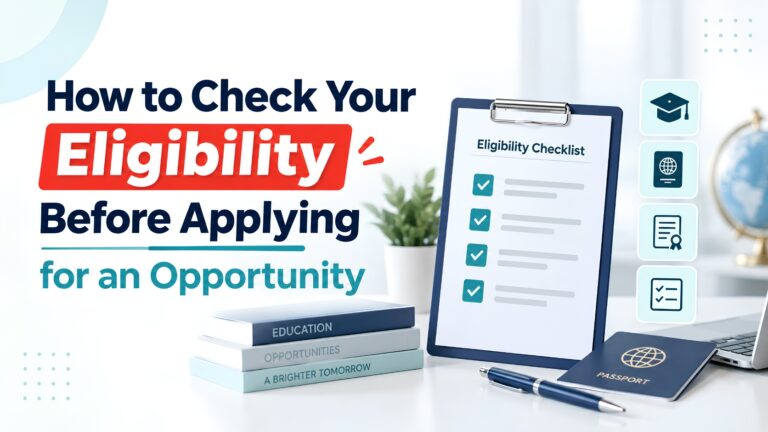
Before writing essays or requesting recommendation letters, confirm that you are actually eligible.
Check every eligibility condition
Scholarships may restrict applications according to nationality, residence, academic level, subject, professional experience, age or other programme-specific criteria.
For example, Commonwealth Master’s Scholarships are limited to candidates from specified eligible Commonwealth countries and have their own academic and financial eligibility conditions. Erasmus Mundus Joint Masters, meanwhile, are open to students worldwide, but individual master’s programmes determine their own application procedures and entry requirements.
Do not assume that eligibility for one scholarship means you qualify for another.
Record the exact deadline
Write down the date, time and time zone shown by the official provider. Also check whether separate deadlines apply to references, university admission or supporting documents.
Submitting early is safer than relying on the final few hours, particularly when documents need to be uploaded through an online portal.
Prepare Your Academic Documents
Academic records are among the most common scholarship requirements.
Transcripts and degree certificates
Depending on the programme, you may need:
- university transcripts
- degree certificates
- current or provisional transcripts
- certified translations
- grading information
Requirements differ significantly. The Commonwealth Scholarship Commission, for example, requires complete higher-education transcripts, including all pages and certified translations where documents are not in English. Missing documentation can make an application ineligible.
Chevening uses a different process: applicants progressing to the interview stage are required to upload their undergraduate degree certificate, and its current guidance specifically states that undergraduate transcripts are not accepted in place of that certificate.
This illustrates why you should never create one universal document list and assume it applies everywhere.
Prepare Your Personal and Identification Documents
Many scholarships need evidence of who you are and whether you meet nationality or residency conditions.
Passport or national identification
Make sure your passport or national ID is valid and that scans are clear.
For Commonwealth Master’s Scholarships, applicants must provide proof of citizenship or qualifying refugee status through a valid passport or national identity document showing relevant personal details.
Other programmes may request different evidence, so check the official instructions before uploading personal documents.
Plan Your Personal Statement and Written Responses
Written sections are often where you explain the connection between your background, goals and the scholarship.
Do not use one generic essay everywhere
You might be asked for a:
- personal statement
- motivation letter
- study plan
- career plan
- leadership essay
- development-impact statement
- research proposal.
These are not always interchangeable.
Commonwealth scholarship applications, for example, assess factors such as academic merit and, depending on the programme, development impact. For doctoral awards, research-proposal quality can also form part of assessment.
Before drafting, read the official selection criteria and answer the question actually being asked. Reusing relevant experiences is reasonable, but your final response should be tailored to each programme.
Arrange Your Recommendation Letters Early
References can become one of the biggest delays because another person controls part of the process.
Choose appropriate referees
Select people who can genuinely discuss your academic ability, research, professional experience or suitability for the opportunity.
Give them enough notice and provide useful context, including:
- scholarship name
- programme or course
- submission deadline
- your CV
- relevant achievements
- official reference instructions.
The submission method matters too. Commonwealth Master’s applicants currently collect references and upload them through the official application system, while Chevening asks applicants for two referees and later requires reference letters if they reach the interview stage.
Never assume that a referee can simply email a letter after the deadline.
Check Whether University Admission Is Separate
One common source of confusion is assuming that a scholarship application automatically counts as an application to the university.
Scholarship and admission can be different processes
For Erasmus Mundus Joint Masters, students apply directly to the institution running the selected programme, and each master’s website provides its own entry requirements and application process.
Similarly, the Commonwealth Scholarship Commission explains that some of its scholarship routes do not require a university offer at scholarship-application stage, although applicants may still need to seek university admission separately.
Always establish whether you need:
- a scholarship application
- a university application or
- both.
Final Scholarship Application Checklist
Before clicking submit, check that you have:
- confirmed your eligibility
- checked the official deadline and time zone
- completed every required section
- uploaded the correct academic records
- prepared proof of identity where required
- arranged all references
- answered each essay question fully
- checked whether university admission is separate
- used the required document formats and file sizes
- reviewed names, dates and contact details
- saved a copy of your application where possible.
The Commonwealth Scholarship Commission warns that required documents submitted outside its official system are not accepted, demonstrating why submission instructions matter just as much as the documents themselves.
Conclusion
A strong scholarship application checklist is less about collecting as many documents as possible and more about preparing exactly what the official programme requires.
Start with eligibility and deadlines, organise your academic and identity documents, contact referees early and give yourself enough time to develop your written responses. Finally, compare everything against the current official instructions before submitting, because requirements can change between programmes and application cycles.
FAQs
What documents are usually required for scholarship applications?
Common requirements include transcripts, degree certificates, identification, references and written statements. However, the exact documents vary considerably between scholarships.
Do I need a university offer before applying for a scholarship?
Not always. Some scholarships require admission first, while others allow you to apply for funding before receiving an offer. Check both the scholarship and university instructions.
Should I prepare recommendation letters before applications open?
You can identify suitable referees and speak to them early, but always wait for the current programme instructions before deciding on the exact format or submission method.
Can I use the same personal statement for different scholarships?
It is better to tailor each statement. Scholarships may assess different priorities, such as academic merit, leadership, research potential or development impact.
Mindship Global Tip
Create one Scholarship Application Folder for every opportunity. Keep the official link, eligibility criteria, deadline, document checklist, essay drafts and reference status together. This simple system makes it much easier to see what is complete and what still needs attention.
Disclaimer
Mindship Global shares verified educational opportunities for informational purposes only. Always verify eligibility, funding, deadlines, required documents and application requirements through the official programme website before applying.