
Erasmus Mundus TCCM Scholarship 2027–2029
The Erasmus Mundus TCCM Scholarship 2027 offers fully funded two-year Master's studies in Theoretical Chemistry and Computational Modelling across five European countries. Selected students receive full tuition coverage, health insurance and a monthly allowance of €1,400.
Erasmus Mundus TCCM Scholarship 2027–2029 in Europe (Fully Funded)
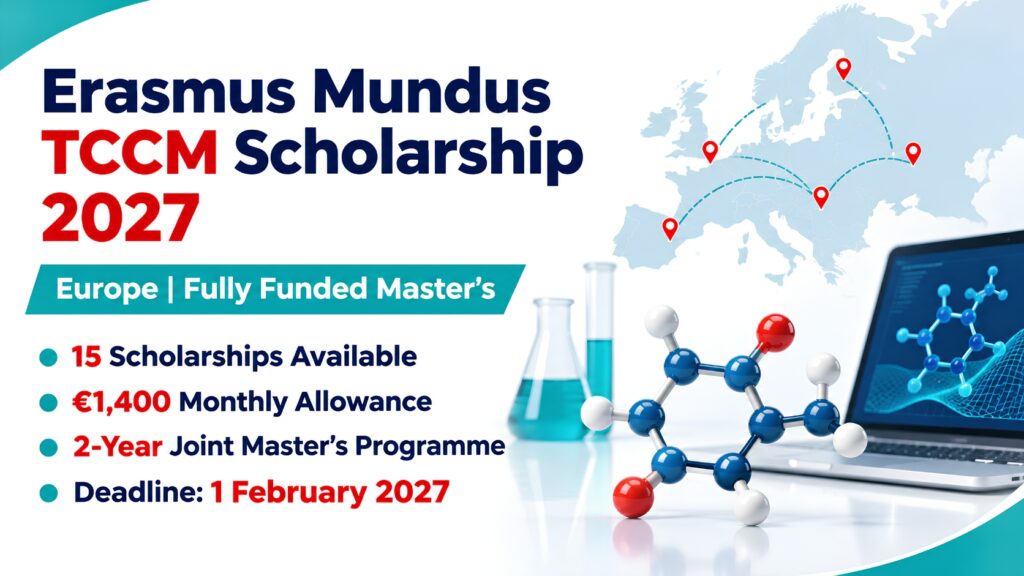
Quick Overview
| Host Organisation | Erasmus Mundus TCCM University Consortium |
|---|---|
| Coordinating University | Universidad Autónoma de Madrid (UAM) |
| Funding Organisation | European Union — Erasmus Mundus |
| Host Countries | Spain, France, Italy, Belgium and the Netherlands |
| Opportunity Type | Erasmus Mundus Joint Master's Scholarship |
| Degree/Academic Level | Master's |
| Programme Name | Theoretical Chemistry and Computational Modelling (TCCM) |
| Funding Status | Fully Funded |
| Available Scholarships | 15 Advertised Annually |
| Monthly Allowance | €1,400 |
| Tuition Fees | Fully Covered for Scholarship Recipients |
| Health Insurance | Provided |
| Duration | 2 Years / 24 Months |
| Academic Credits | 120 ECTS |
| Study Period | 2027–2029 |
| Eligible Applicants | Qualified European and Non-European Students |
| Fields of Study | Chemistry, Physics, Materials Science and Related Scientific Disciplines |
| Teaching Language | English |
| English Requirement | IELTS 6.5 or Equivalent; Approved English-Medium Degree Exemption Available |
| Primary Deadline | 1 February 2027 |
Unlock More with Your FREE Account
Get free academic and professional tools, the CV Builder, Webinars & Live Sessions, the Growth Library, saved opportunities, personalised recommendations and deadline reminders — all in one place.
Detailed Description
The Erasmus Mundus TCCM Scholarship 2027–2029 offers an international postgraduate study opportunity in Theoretical Chemistry and Computational Modelling.
The programme is coordinated by Universidad Autónoma de Madrid in Spain and delivered by a consortium of eight European universities.
It is designed for students who want to develop advanced knowledge of molecular science, theoretical chemistry, computational methods and scientific simulations.
The Erasmus Mundus Joint Master's programme combines academic education, scientific research and international mobility.
Participants study at institutions in different European countries and gain experience using computational techniques to investigate chemical, biological and materials-related problems.
Participating Universities
The TCCM consortium consists of eight degree-awarding universities across five countries.
Spain
- Universidad Autónoma de Madrid.
- Universitat de Barcelona.
- Universitat de València.
France
- Université de Toulouse.
Italy
- Università degli Studi di Perugia.
- Università degli Studi di Trieste.
Belgium
- KU Leuven.
The Netherlands
- University of Groningen.
Programme Structure
The Master's programme lasts two academic years and comprises 120 ECTS credits.
First Year — Academic Foundation
Students begin at their selected host university and study theoretical and computational chemistry.
The first year includes two academic tracks.
Track 1 is offered by universities in Spain, France and Belgium.
Track 2 is offered by universities in Italy and the Netherlands.
Students develop theoretical knowledge, computational techniques and an understanding of scientific applications.
Depending on the study track, they may undertake their second semester at another participating university.
Second Year — Advanced Study and Research
The second year provides advanced academic training and scientific research opportunities.
Students complete specialised coursework, with opportunities for mobility between participating institutions.
The final semester is dedicated to the Master's thesis.
Students undertake a research project under academic supervision, potentially involving collaboration with researchers or associated partners of the consortium.
International Mobility
All students must complete study periods in at least two different consortium countries.
Each compulsory mobility period must represent at least 30 ECTS credits.
The programme's mobility arrangements are developed with academic supervisors and must satisfy the consortium's requirements.
Main Research Areas
TCCM provides training in scientific subjects such as:
- Theoretical and Computational Chemistry.
- Molecular Modelling and Simulation.
- Quantum Chemistry.
- Materials Design and Nanoscience.
- Biochemistry and Drug Design.
- Astrochemistry.
- Attosecond Science.
- Artificial Intelligence Applications.
- Spectroscopy and Molecular Dynamics.
- Computational Materials Research.
Students interact with university researchers and may gain exposure to scientific computing facilities, research centres and relevant industrial applications.
Degree Awarded
Successful graduates receive a joint Master's qualification recognised by the participating degree-awarding universities.
The programme prepares students for doctoral research and professional careers involving computational chemistry, molecular modelling, materials development and related scientific fields.
Eligibility Criteria
Applicants must meet the official TCCM admission and scholarship requirements.
- Nationality: Applicants from all countries are eligible to apply, including European and non-European nationals.
- Academic qualification: Hold a recognised Bachelor's degree in Chemistry, Physics or Materials Science, or a suitable equivalent.
- Related scientific degrees: Applicants from other scientific disciplines may be considered if their academic preparation meets the required standards.
- Final-year students: Students completing their Bachelor's degree may apply, provided they graduate before 1 September 2027.
- English proficiency: Demonstrate the required English-language ability through an accepted qualification or exemption.
- Previous Erasmus Mundus awards: Applicants who have previously received an Erasmus Mundus Joint Master's scholarship cannot receive another scholarship under this programme.
- Scientific preparation: Applicants must have sufficient academic knowledge in the relevant foundational subjects.
Required Scientific Background
For applicants whose Bachelor's degree is not in Chemistry, Physics or Materials Science, TCCM evaluates knowledge in:
- Chemical Bonding.
- Atomic and Molecular Structure.
- Intermolecular Interactions.
- General Physics.
- Mathematics.
- General Physical Chemistry.
- Thermodynamics and Kinetics.
- Spectroscopy.
Applicants with minor deficiencies may be required to undertake supplementary courses.
However, applicants lacking preparation in more than two of the required areas are not eligible for admission.
English-Language Requirements
TCCM accepts recognised evidence of English proficiency.
The official programme lists:
- IELTS Academic: 6.5.
- TOEFL iBT: 4.5 under the updated scoring scale, equivalent to approximately 90 under the previous scale.
- Cambridge English: First Certificate demonstrating B2 level.
- Other internationally recognised equivalent qualifications.
English-Test Exemption
Applicants who completed their previous degree in English may qualify for an exemption from submitting a separate English-language test certificate.
They must provide an official document from their university confirming that their degree was taught in English.
Am I eligible?
Answer a few quick questions and see how your profile matches this opportunity.
Your answers stay in your browser. Nothing is sent to us.
Build a CV for This Opportunity
Free, no account needed, and downloadable as Word or PDF.
Build my CVBenefits
Selected Erasmus Mundus TCCM scholars receive:
- Full Tuition Coverage: Registration and programme tuition fees covered.
- Monthly Living Allowance: €1,400 per month.
- Scholarship Duration: Support for up to 24 months, subject to scholarship conditions.
- Health Insurance: Coverage under the programme's insurance arrangements.
- International Mobility: Financial support through the scholarship allowance for approved study mobility.
- Travel and Relocation Expenses: The monthly allowance is intended to contribute towards travel, visa, installation and living expenses.
- European Education: Academic experience across participating European institutions.
- Scientific Training: Access to advanced computational chemistry education.
- Research Supervision: Guidance from academic researchers and supervisors.
- Master's Thesis: Opportunity to undertake a supervised scientific research project.
- Professional Networking: Interaction with researchers, students and associated scientific institutions.
- Joint Master's Qualification: Internationally recognised postgraduate qualification upon successful completion.
Documents Required
The official TCCM application guidance identifies the following documents.
- Europass CV: Updated academic and professional curriculum vitae.
- Valid Passport: Identification document for the applicant.
- Academic Transcripts: University academic records showing completed courses and grades.
- Bachelor's Qualification: Degree evidence or current academic status for final-year applicants.
- English Proficiency Certificate: Accepted English-language qualification, where applicable.
- Medium of Instruction Certificate: Official university confirmation where an English-test exemption applies.
- Motivation Letter: Explanation of academic interests and reasons for applying.
- Two Reference Letters: Academic or professional recommendations submitted through the application system.
- Additional Supporting Documents: Other relevant documents requested by the portal.
Recommendation Letters
Applicants must invite two referees through the official application system.
Referees provide their recommendations according to the instructions they receive.
Applicants should select referees familiar with their academic preparation and suitability for postgraduate scientific study.
Final-Year Students
Students who have not yet completed their Bachelor's degree may apply using their current academic records.
However, successful completion of the degree before 1 September 2027 is required for final admission.
Application Process
Review the Official TCCM Programme
Visit the official TCCM website and read the academic requirements, scholarship conditions and university mobility arrangements.
Confirm Your Academic Eligibility
Check that your Bachelor's qualification meets the required subject and scientific preparation standards.
Review the English Requirements
Confirm that you hold an accepted English-language qualification or qualify for the English-medium degree exemption.
Prepare Your Academic Documents
Gather your passport, academic transcripts, Bachelor's degree information and other required documents.
Create Your Europass CV
Prepare an updated CV describing your academic background, relevant scientific knowledge, projects and research interests.
Write Your Motivation Letter
Explain your reasons for studying computational chemistry, your academic preparation and your future research or professional goals.
Select Your Referees
Identify two suitable referees who can assess your academic abilities and potential for advanced scientific study.
Access the Official Application Portal
Visit the TCCM online application platform and register as a new applicant.
Create Your Account
Enter your personal information, nationality, residence details and a valid email address.
Complete the Application Form
Provide the requested academic and personal details through the application platform.
Upload Your Supporting Documents
Attach the compulsory application materials using the available document-upload sections.
Invite Your Referees
Use the platform to request recommendations from your two selected referees.
Review Your Application
Check the accuracy of your information and verify that the required documents have been uploaded.
Submit Your Application
Complete your online application before 1 February 2027.
Prepare for the Selection Interview
Applicants receiving high evaluation scores may be invited to an interview as part of the final selection process.
Await the Final Decision
The International Pedagogical Committee evaluates shortlisted candidates and determines the scholarship recipients.
Complete University Enrolment
Successful applicants should follow the consortium's instructions concerning final academic documents, enrolment, mobility and scholarship arrangements.
Selection Criteria
Applicants are assessed according to:
- Academic background and previous university performance.
- Suitability of the Bachelor's qualification.
- Academic preparation in relevant scientific subjects.
- Motivation for postgraduate study.
- Relevant academic achievements and merits.
- Quality of the submitted application.
- Supporting academic recommendations.
- Interview performance for shortlisted candidates.
Selection Procedure
After the application deadline, the committee reviews and scores eligible applications.
Applications are ranked according to their evaluation results.
The highest-ranked candidates are invited to an interview.
The committee may contact referees where further information is required.
Following the interviews, the committee makes the final scholarship selection.
Timeline
- Scholarship application deadline1 February 2027
- Application reviewFollowing the February 2027 deadline
- Bachelor's degree completion deadlineBefore 1 September 2027
- Academic year beginsSeptember 2027
- Programme duration24 Months
- Expected completion2029
Why This Opportunity?
- International Master's Degree: Earn a joint qualification from a consortium of European universities.
- Advanced Scientific Training: Develop expertise in theoretical chemistry and computational modelling.
- Research Experience: Undertake supervised scientific research.
- International Mobility: Study in at least two European countries.
- Technical Skill Development: Learn computational techniques used in scientific modelling.
- Academic Networking: Build connections with international researchers and students.
- Career Development: Prepare for opportunities in chemistry, pharmaceutical research and materials science.
- Doctoral Preparation: Build an academic foundation for future PhD research.
Mindship Global Tips
- Check your academic backgroundConfirm that your degree includes the required chemistry, physics and mathematics preparation.
- Review the English requirementPrepare an accepted test score or official Medium of Instruction certificate.
- Contact referees earlyTwo recommendations are required through the application system.
- Prepare a strong CVHighlight scientific coursework, programming abilities and relevant projects.
- Write a focused motivation letterExplain your interest in theoretical chemistry and molecular modelling.
- Review the study tracksUnderstand how university placements and compulsory mobility work.
- Prepare your passportEnsure your identification details match your online application.
- Check previous scholarship eligibilityPrevious Erasmus Mundus Joint Master's recipients cannot receive another award.
- Prepare for an interviewShortlisted applicants may be asked about their academic preparation and motivation.
- Submit before the deadlineComplete the online form before 1 February 2027.
Frequently Asked Questions
Who can apply for the Erasmus Mundus TCCM Scholarship 2027?
Applicants with a recognised Bachelor's degree in Chemistry, Physics, Materials Science or a suitable related scientific discipline may qualify, subject to the programme's academic and English-language requirements.
Is the TCCM Scholarship fully funded?
Yes, for selected Erasmus Mundus scholarship holders. It covers registration and tuition fees, health insurance and a €1,400 monthly allowance intended to support living and mobility-related expenses.
How many scholarships are available?
The consortium advertises 15 fully funded Erasmus Mundus scholarships annually.
Can final-year Bachelor's students apply?
Yes. Final-year students may apply, provided they complete their qualifying degree before 1 September 2027.
Is IELTS compulsory?
Applicants must demonstrate English proficiency. The programme accepts IELTS 6.5 or equivalent qualifications, while graduates who completed their degrees in English may qualify for an exemption with official university confirmation.
Can students from other scientific backgrounds apply?
Yes, applicants from other scientific disciplines may be considered. However, they must meet the programme's foundational subject requirements, and some may need supplementary courses.
Can previous Erasmus Mundus scholarship recipients apply?
Students who previously received an Erasmus Mundus Joint Master's scholarship are not eligible to receive another such scholarship.
Is accommodation provided free of charge?
The official scholarship benefits do not separately guarantee free housing. Students normally use their monthly allowance for accommodation and other living expenses.
What is the application deadline?
The official 2027 Erasmus Mundus TCCM Scholarship deadline is 1 February 2027.
Official Application Link
- Official TCCM Websitewww.emtccm.org
- Apply Here — Official Application Portalwww.emtccm.org
- Erasmus Mundus Scholarship Informationwww.emtccm.org
- Eligibility and Application Guidancewww.emtccm.org
- Programme Overview and Mobilitywww.emtccm.org
- Official 2025–2030 Study Planwww.emtccm.org
- 2027 Scholarship Announcement Posterwww.emtccm.org
Disclaimer
📌 Mindship Global shares verified educational opportunities for informational purposes only. Applicants should verify eligibility, funding arrangements, deadlines, required documents, and application requirements through the official website before applying.
Questions & Comments
No questions yet. If something about this opportunity is unclear, ask - the answer helps whoever reads it next.
Ask a question
Deadlines pass quickly - passing it on is often what gets someone to apply in time.