
Knight Science Journalism Fellowship 2027–2028
The Knight Science Journalism Fellowship 2027–2028 offers experienced science journalists from around the world a funded 9.5-month professional development programme at MIT in Cambridge, USA. Ten selected fellows receive an $87,500 stipend, an additional $5,000 for travel and housing, health insurance and access to university courses, research facilities and journalism training.
Knight Science Journalism Fellowship 2027–2028 at MIT in USA (Funded)
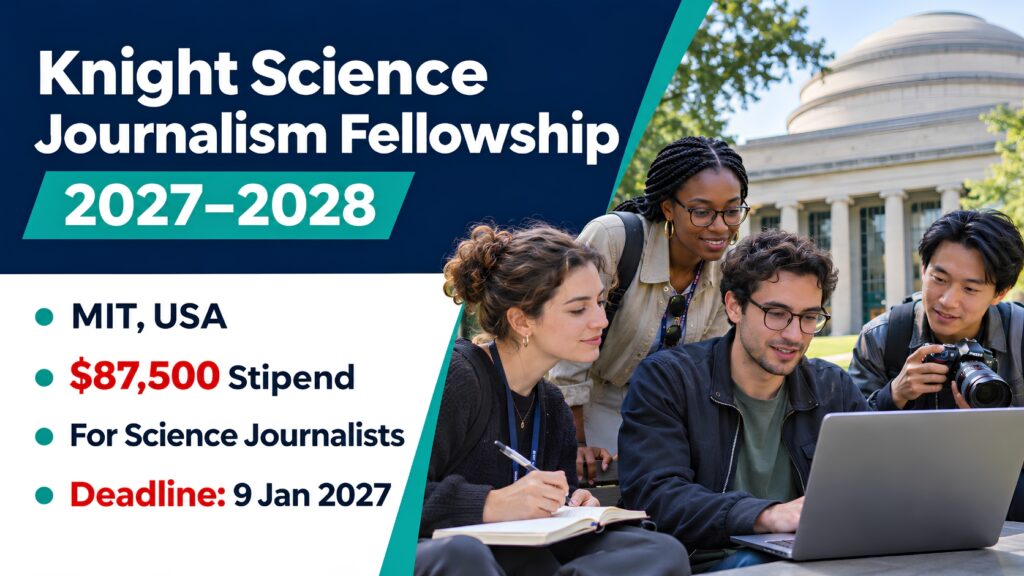
Quick Overview
| Host Organisation | Knight Science Journalism Program at MIT |
|---|---|
| Host Institution | Massachusetts Institute of Technology (MIT) |
| Host Country | United States of America |
| Location | Cambridge, Massachusetts, USA |
| Opportunity Type | International Journalism Fellowship |
| Degree/Academic Level | Professional (Experienced Journalists) |
| Funding Status | Funded Fellowship (Stipend) |
| Fellowship Stipend | USD $87,500 |
| Additional Travel and Housing Stipend | USD $5,000 |
| Health Insurance | Provided for Fellows and Accompanying Family Members |
| Childcare Subsidy | USD $500–$750 Per Month for Eligible Fellows |
| Number of Fellowships | 10 |
| Duration | 9.5 Months |
| Programme Period | Mid-August 2027–May 2028 |
| Eligible Applicants | Full-Time Journalists Worldwide |
| Minimum Experience | 3 Consecutive Years of Relevant Journalism Experience |
| Fields | Science, Health, Technology and Environmental Journalism |
| English Requirement | English Proficiency Verified for International Fellows; No Compulsory IELTS Test |
| Application Platform | Submittable |
| Primary Deadline | 9 January 2027, 11:59 PM EST |
| Reference Letter Extension | Until 15 January 2027, 11:59 PM EST, If Needed |
Unlock More with Your FREE Account
Get free academic and professional tools, the CV Builder, Webinars & Live Sessions, the Growth Library, saved opportunities, personalised recommendations and deadline reminders — all in one place.
Detailed Description
The Knight Science Journalism Fellowship 2027–2028 is an international professional development programme organised by the Knight Science Journalism Program at the Massachusetts Institute of Technology (MIT) in the United States.
Established in 1983, the programme supports experienced journalists who report on science, health, technology and environmental issues. It aims to strengthen science journalism by giving professionals dedicated time to deepen their expertise, develop reporting projects and learn from researchers and other journalists.
Each year, ten journalists are selected for the Academic-Year Fellowship. Participants spend approximately nine and a half months in the Cambridge and Boston area, engaging with the academic communities of MIT, Harvard University and other nearby institutions.
Fellowship Activities
The programme combines structured training with independent learning. Fellows participate in:
- Seminars led by researchers and media professionals.
- Journalism and storytelling workshops.
- Scientific and technological field trips.
- University courses at MIT, Harvard and other institutions.
- Independent research and reporting projects.
- Professional discussions and networking activities.
Fellows must develop an individual journalism-related research project that makes meaningful use of the resources available in Cambridge and Boston.
Projects may involve long-form investigations, science reporting series, multimedia journalism, documentary research, audio storytelling or other journalistic formats.
Academic and Professional Development
Fellows design their own course of study and must include at least one science course each semester. Auditing university classes requires the relevant instructor's approval. Throughout the programme, fellows participate in regular project discussions and receive opportunities to improve their technical and storytelling skills.
At the end of the fellowship, participants formally present their research projects. Many fellows subsequently develop their work into articles, documentaries, podcasts or books. The fellowship is designed for professional journalists rather than students seeking a postgraduate qualification.
Eligibility Criteria
Applicants must meet the following official requirements:
- Professional status: Be a full-time journalist, either employed by a media organisation or working as a freelancer.
- Work experience: Have at least three consecutive years of experience covering science, health, technology or the environment.
- Professional roles: Eligible backgrounds include reporting, writing, editing, producing, illustration, filmmaking, photojournalism and book authorship.
- Media formats: Experience may come from newspapers, magazines, television, radio or digital media.
- International eligibility: Journalists from countries worldwide may apply, subject to US visa restrictions.
- Visa eligibility: Be able to obtain the necessary visa to reside in the United States during the fellowship.
- Previous fellowships: Must not have completed a residential fellowship lasting four months or longer within the two years before applying.
- Professional commitment: Demonstrate a sustained commitment to journalism.
- Residency: Be available to reside full-time in the Cambridge/Boston area during the fellowship.
- Programme participation: Be able to attend required seminars, workshops, field trips and other activities.
- Research project: Propose a journalism-related project suitable for development during the fellowship.
- Outside employment: Agree not to undertake other paid professional work without written permission from the fellowship director.
International Applicants
International candidates are encouraged to apply. Selected participants normally receive MIT sponsorship for a J-1 visa, with J-2 visas available for eligible dependants. MIT must verify the English proficiency of international fellows. This may be established through interviews or an English-language assessment.
Previous Fellowship Restrictions
Applicants who recently completed a residential academic fellowship lasting at least four months are generally ineligible if it falls within the two-year exclusion period. However, reporting fellowships and grants that provide supplemental funding while journalists continue working full-time may be permitted.
Am I eligible?
Answer a few quick questions and see how your profile matches this opportunity.
Your answers stay in your browser. Nothing is sent to us.
Build a CV for This Opportunity
Free, no account needed, and downloadable as Word or PDF.
Build my CVBenefits
Selected Knight Science Journalism Fellows receive financial support and professional training opportunities.
Financial Benefits
- Fellowship Stipend: USD $87,500 paid over 9.5 months.
- Travel and Housing Stipend: Additional one-time payment of USD $5,000 near the beginning of the fellowship.
- Health Insurance: Coverage for fellows and accompanying family members.
- Childcare Subsidy: USD $500–$750 per month for qualifying fellows.
- Transportation Benefits: Access to free or subsidised public transportation.
- Cultural Access: Free or discounted entry to participating museums and other programmes.
Academic and Professional Benefits
- MIT Learning Opportunities: Audit selected university courses with instructor approval.
- Harvard and Local University Access: Opportunities to attend suitable classes at participating institutions.
- Research Development: Dedicated time to pursue a journalism-related research project.
- Scientific Seminars: Learn from researchers and specialists.
- Journalism Workshops: Improve reporting, writing, storytelling and technical skills.
- Research Field Trips: Visit scientific institutions and research facilities.
- Professional Networking: Build connections with journalists, scientists and academics.
- Project Presentation: Present completed fellowship work to the programme community.
- International Experience: Spend an academic year within the Cambridge/Boston research environment.
Documents Required
The official application requires the following materials:
- Statement of Purpose: Maximum 500 words explaining why the applicant wishes to participate and how the fellowship relates to their professional goals.
- Career Summary: Maximum 200 words describing the applicant's journalism career.
- Video Introduction: A 30-second video introducing the applicant and explaining their interest in the fellowship.
- Curriculum Vitae or Résumé: Professional experience, education and relevant achievements.
- Research Project Proposal: Maximum 500 words outlining a journalism-related project to develop during the fellowship.
- Five Work Samples: Relevant published or broadcast journalism demonstrating the applicant's abilities.
- Three Professional References: Contact details for three individuals able to assess the applicant's professional work and commitment to journalism.
Additional Requirements:
- Freelance journalists should include a list of assignments completed during the previous 12 months, showing each story, publication or broadcaster, and publication date.
- Applicants whose work samples are in languages other than English must provide translations.
- Referees submit recommendation letters through the official application system after receiving automatically generated requests.
Application Process
Review the Official Fellowship
Visit the Knight Science Journalism website and read the eligibility criteria, programme expectations and application instructions for 2027–2028.
Confirm Your Professional Eligibility
Ensure that you are a full-time journalist with at least three consecutive years of relevant reporting experience.
Review the Residency Requirements
Confirm that you can live in the Boston/Cambridge area throughout the fellowship and participate in the required activities.
Choose Your Research Project
Identify a journalism-related project that would benefit from MIT's academic resources, scientific expertise and professional networks.
Prepare Your Curriculum Vitae
Create a professional CV describing your journalism experience, education, achievements and relevant published work.
Write Your Statement of Purpose
Prepare a statement of no more than 500 words explaining your motivation and professional goals.
Prepare Your Career Summary
Write a concise summary of your journalism career in no more than 200 words.
Write Your Research Proposal
Describe your proposed journalism project in no more than 500 words, explaining how you would use the resources available during the fellowship.
Record Your Video Introduction
Create a 30-second video introducing yourself and explaining why you want to become a Knight Science Journalism Fellow.
Select Your Work Samples
Choose five strong journalism samples relevant to science, technology, health or the environment. Include English translations where necessary.
Choose Your Professional Referees
Identify three suitable individuals who can provide recommendations about your professional abilities and commitment to journalism.
Access the Official Application Portal
Visit the Knight Science Journalism Submittable page and create or sign in to your applicant account.
Complete the Application Form
Enter the required personal and professional information and upload the relevant supporting materials.
Request Your Recommendation Letters
Provide your referees' details through Submittable so the system can send them the official recommendation requests.
Review Your Application
Check your written responses, video introduction, project proposal, work samples and referee contact information.
Submit Before the Deadline
Complete your application by 9 January 2027 at 11:59 PM Eastern Standard Time.
Monitor Reference Submissions
Ensure that your referees submit their letters by the main deadline or, where the permitted extension applies, by 15 January 2027.
Attend an Interview if Shortlisted
Selected applicants participate in a video interview with the fellowship selection committee.
Await the Final Decision
The programme normally announces its ten selected fellows during April 2027.
Complete Fellowship Arrangements
Successful international applicants should follow MIT's visa instructions and arrange accommodation, travel and the required fellowship documentation.
Selection Criteria
The Knight Science Journalism Program seeks experienced journalists with strong professional achievements and sustained commitment to their field. Official selection considerations include:
- Professional excellence: Demonstrated achievement in journalism.
- Relevant experience: Established reporting in science, health, technology or environmental subjects.
- Professional commitment: Long-term dedication to journalism.
- Research proposal: A meaningful journalism-related project that uses MIT and local resources.
- Professional development: Clear reasons for participating in the fellowship.
- Work samples: Evidence of journalism skills, reporting quality and professional abilities.
- Professional references: Assessments from individuals familiar with the applicant's work.
- Interview performance: Evaluation of shortlisted applicants during video interviews.
Selection Procedure
Applications are reviewed by a panel of experienced science journalists between January and March. Finalists are normally notified in early March and invited to participate in video interviews. The ten selected fellows are usually announced in April.
Timeline
- Application Period Began15 November 2026
- Application Deadline9 January 2027, 11:59 PM EST
- Extended Reference Deadline15 January 2027, 11:59 PM EST, If Needed
- Application ReviewJanuary–March 2027
- Finalist InterviewsMarch 2027
- Selection ResultsApril 2027
- Fellowship BeginsMid-August 2027
- Fellowship EndsMay 2028
- Programme DurationApproximately 9.5 Months
Why This Opportunity?
- Professional Development: Strengthen expertise in science journalism and investigative reporting.
- MIT Academic Environment: Learn from researchers working across scientific and technological disciplines.
- Journalism Innovation: Develop advanced storytelling and multimedia reporting skills.
- Research Opportunity: Pursue an independent project with institutional resources and expert access.
- International Networking: Build professional connections with journalists and researchers worldwide.
- Interdisciplinary Learning: Explore scientific subjects beyond an existing reporting specialisation.
- Career Development: Build experience relevant to journalism, publishing and science communication.
- Professional Community: Join an established network of Knight Science Journalism Fellows and alumni.
Mindship Global Tips
- Check your professional statusThe programme is restricted to full-time journalists rather than part-time contributors.
- Verify your experienceEnsure you have at least three consecutive years of eligible science-related journalism experience.
- Select strong work samplesChoose five pieces that demonstrate your reporting abilities and relevant interests.
- Develop a practical projectExplain how MIT and the Cambridge/Boston research environment would contribute to your work.
- Follow the word limitsKeep your statement of purpose and project proposal within 500 words each.
- Prepare your videoUse the 30-second introduction to communicate your motivation clearly.
- Contact referees earlyThree recommendations are required, so allow sufficient time for their submission.
- Review visa eligibilityInternational applicants must be able to obtain an appropriate US visa.
- Budget for accommodationHousing and travel are supported through stipends rather than guaranteed free services.
- Follow the AI policyWrite your own application and disclose any permitted AI-assisted editing.
- Meet the primary deadlineSubmit your application by 9 January 2027 rather than relying on older fellowship deadlines.
Frequently Asked Questions
Who can apply for the Knight Science Journalism Fellowship 2027–2028?
Full-time journalists with at least three consecutive years of reporting experience in science, health, technology or the environment may apply, subject to the programme's other eligibility requirements.
How much funding do fellows receive?
Each selected Academic-Year Fellow receives an $87,500 stipend over 9.5 months, plus a one-time $5,000 travel and housing stipend and other eligible benefits.
Is accommodation free?
No. Fellows are responsible for arranging and paying for their own accommodation, using the financial support provided by the programme.
Is IELTS compulsory?
No compulsory IELTS or TOEFL certificate is required for the initial application. However, MIT must verify English proficiency for international fellows, which may involve interviews or language assessments.
Can undergraduate or Master's students apply?
Being a student does not itself qualify someone for this fellowship. Applicants must be full-time working journalists who meet the professional experience requirements.
Can freelance journalists apply?
Yes. Full-time freelance journalists are eligible and should provide details of relevant assignments completed during the previous 12 months.
Is a university degree required?
The official eligibility conditions focus on professional journalism experience rather than a particular university qualification. Applicants should demonstrate their professional background through their CV and work samples.
Can fellows continue other paid journalism work?
Generally, fellows must refrain from outside paid professional work during the fellowship unless the director provides written permission.
What is the application deadline?
The main application deadline is 9 January 2027 at 11:59 PM EST.
Official Application Link
Disclaimer
📌 Mindship Global shares verified educational opportunities for informational purposes only. Applicants should verify eligibility, funding arrangements, deadlines, required documents, and application requirements through the official website before applying.
Questions & Comments
No questions yet. If something about this opportunity is unclear, ask - the answer helps whoever reads it next.
Ask a question
Deadlines pass quickly - passing it on is often what gets someone to apply in time.