
Atlantic Fellows for Social and Economic Equity 2027–28
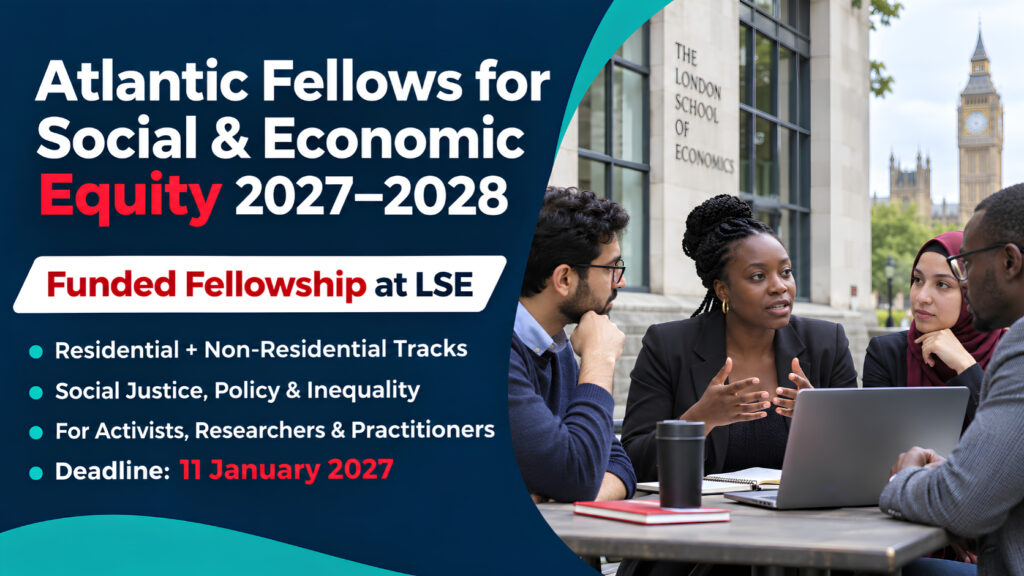
The Atlantic Fellows for Social and Economic Equity programme 2027–28 is a fully funded fellowship at the London School of Economics and Political Science for mid-career changemakers committed to fighting inequality. Fellows join a global community, complete an intensive fellowship year in London, and undertake a Master's degree or a Postgraduate Certificate, depending on their track.
Atlantic Fellows for Social and Economic Equity 2027–28 | Fully Funded Fellowship at LSE
Quick Overview
| Host Organisation | Atlantic Fellows for Social and Economic Equity, London School of Economics and Political Science (LSE) |
|---|---|
| Host Country | United Kingdom |
| Location | London, United Kingdom |
| Opportunity Type | Fellowship – Fully Funded |
| Degree/Academic Level | Professional – Mid-career changemakers |
| Funding Status | Fully Funded |
| Duration | One year – active fellowship year |
| Eligible Applicants | Mid-career changemakers with at least 7 years of experience |
| Application Fee | Not specified on the official programme page |
| IELTS/English Requirement | Must meet LSE's English Language Requirements |
| Deadline | 11 January 2027, 5.00pm UK time |
Unlock More with Your FREE Account
Get free academic and professional tools, the CV Builder, Webinars & Live Sessions, the Growth Library, saved opportunities, personalised recommendations and deadline reminders — all in one place.
Detailed Description
The Atlantic Fellows for Social and Economic Equity programme, housed at the LSE International Inequalities Institute, is a fully funded fellowship that brings together policymakers, activists, practitioners, artists and movement-builders from around the world to explore and challenge the root causes of inequality. It is a transformative community working toward just and equitable alternatives to today's deeply unjust and unequal world.
The fellowship offers two tracks. Residential Fellows undertake the MSc in Inequalities and Social Science at LSE during their active fellowship year, while Non-Residential Fellows undertake a Postgraduate Certificate in Social and Economic Equity. Participants in both tracks take part in rigorous academic coursework, leadership and skills development, and practical approaches to fostering social change, centred around key learning modules. The curriculum brings together a structural analysis of global inequalities and examines the ways that people resist and challenge inequalities, through lectures, panel debates, presentations, group work and community-building.
The active fellowship year is an immersive year at LSE, and an intense and demanding year that requires full commitment from Fellows as they join a community that helps to support, challenge and deepen their learning and practice. Fellows are drawn from around the world, with a majority coming from the Global South, and the programme is especially keen to support applicants who live in the Global South, who come from marginalised or historically underrepresented groups, or who do not otherwise have the resources to finance their participation.
Eligibility Criteria
- Have at least 7 years of experience challenging inequalities.
- Be able to meet LSE's English Language Requirements.
- For the Residential track, qualify for admission to the MSc in Inequalities and Social Science programme at LSE.
- Be a mid-career changemaker committed to fighting inequality, including policymakers, activists, practitioners, artists, researchers and movement-builders.
- Be ready to commit fully to an intensive fellowship year at LSE.
- Be ready to learn from and contribute to the AFSEE Community.
Am I eligible?
Answer a few quick questions and see how your profile matches this opportunity.
Your answers stay in your browser. Nothing is sent to us.
Build a CV for This Opportunity
Free, no account needed, and downloadable as Word or PDF.
Build my CVBenefits
- A fully funded fellowship at the London School of Economics and Political Science.
- For Residential Fellows, the MSc in Inequalities and Social Science at LSE during the active fellowship year.
- For Non-Residential Fellows, a Postgraduate Certificate in Social and Economic Equity.
Rigorous academic coursework, leadership and skills development, and practical approaches to fostering social change. - Learning in a research-rich environment at LSE, with scholars, innovators, activists and social change organisations.
- Membership of a lifelong global community of Atlantic Fellows, across seven Atlantic Fellowships worldwide.
- Support, challenge and deepening of learning and practice from the AFSEE community.
Documents Required
- A completed online application through LSE's Graduate Application System.
A CV. - Transcripts, or a statement that you hold no degree, where applicable.
- A statement of academic purpose, with specific requirements for Residential applicants and for Non-Residential applicants.
- Two referees.
Application Process
Check Your Eligibility
Read the official AFSEE eligibility and selection criteria carefully, and check that you have at least 7 years of experience challenging inequalities, that you meet LSE's English Language Requirements, and, for the Residential track, that you qualify for admission to the MSc in Inequalities and Social Science at LSE.
Prepare Your Application
Prepare your CV, transcripts or a statement that you hold no degree, a statement of academic purpose following the specific guidance for your track, and nominate two referees.
Submit Your Application
Submit your completed online application through LSE's Graduate Application System, through the official AFSEE Apply page, by 11 January 2027 at 5.00pm UK time.
Attend an Interview, If Shortlisted
If you are shortlisted, attend an interview. Shortlisted applicants are notified in mid-March 2027, and interviews are held in March 2027.
Receive a Decision
Applicants are notified of final decisions in mid-April 2027, and the 2027–28 Cohort is announced in mid-July 2027.
Selection Criteria
- A clear idea of who you are, your values and your work, in relation to your experience in challenging inequalities.
- Clarity of vision and future impact.
- Commitment and readiness to learn from and contribute to the AFSEE Community.
- Reflexivity.
- Boldness and readiness to challenge power, imagination and daring in envisioning solutions, and care and collaboration in practice.
- Recognition of the significance of lived experience of inequality, and lived experience that informs practice.
- Focus on commitment to changing the world through collective and collaborative approaches, rather than on advancing your own career.
- For Residential Fellows, the criteria for the Residential track, and for Non-Residential Fellows, the criteria for the Non-Residential track, as set out on the official selection criteria page.
Timeline
- Applications open7 October 2026
- Information webinar19 October 2026
- Application tips webinar16 November 2026
- Applications close11 January 2027, 5.00pm UK time
- Shortlisted applicants notifiedMid-March 2027
- InterviewsMarch 2027
- Final decisions notifiedMid-April 2027
- Cohort announcedMid-July 2027
Why This Opportunity?
- Join a fully funded fellowship at LSE, focused on challenging the root causes of inequality.
- Learn from scholars, innovators, activists and social change organisations, and the latest academic research on inequalities.
- Complete a Master's degree or a Postgraduate Certificate, depending on your track.
- Build leadership and practical skills for social change, through rigorous coursework and community learning.
- Join a lifelong global community of Atlantic Fellows, with a majority from the Global South.
- Contribute to a community working toward just and equitable alternatives to today's deeply unjust and unequal world.
Mindship Global Tips
- Start earlyGive yourself enough time to prepare a strong application before 11 January 2027.
- Check eligibility carefullyMake sure you have at least 7 years of experience and meet LSE's English Language Requirements before applying.
- Choose the right trackResidential Fellows undertake the MSc in Inequalities and Social Science, while Non-Residential Fellows undertake a Postgraduate Certificate in Social and Economic Equity.
- Show your experience clearlyGive a clear idea of who you are, your values and your work, in relation to your experience in challenging inequalities.
- Show your vision and impactExplain your clarity of vision and future impact, and your commitment and readiness to learn from and contribute to the AFSEE Community.
- Prepare your statement carefullyFollow the specific statement of academic purpose guidance for Residential or Non-Residential applicants.
- Ask your referees earlyNominate two referees and give them enough time to submit their references.
Frequently Asked Questions
Is IELTS required?
Applicants must be able to meet LSE's English Language Requirements. The official AFSEE Apply page states that applicants are not required to sit an English-language test before they submit their application.
Is there an application fee?
No application fee is mentioned on the official AFSEE programme pages checked, so no fee amount is stated for this fellowship.
Can I apply if I do not have an undergraduate degree?
The official AFSEE Apply page lists this as a frequently asked question, and the documents required include transcripts, or a statement that you hold no degree, where applicable. Check the official AFSEE eligibility page for the requirements for your track.
What are the two tracks?
Residential Fellows undertake the MSc in Inequalities and Social Science at LSE during their active fellowship year, while Non-Residential Fellows undertake a Postgraduate Certificate in Social and Economic Equity.
Who can apply?
Mid-career changemakers with at least 7 years of experience challenging inequalities, including policymakers, activists, practitioners, artists, researchers and movement-builders from around the world, who meet LSE's English Language Requirements.
How long is the fellowship?
The active fellowship year is one year, centred around key learning modules at LSE.
What is the deadline?
Applications close on 11 January 2027 at 5.00pm UK time.
When will I hear the outcome?
Shortlisted applicants are notified in mid-March 2027, final decisions are notified in mid-April 2027, and the 2027–28 Cohort is announced in mid-July 2027.
Is the fellowship fully funded?
Yes, the Atlantic Fellows for Social and Economic Equity programme is described on the official LSE page as a fully funded fellowship.
What documents do I need?
A completed online application through LSE's Graduate Application System, a CV, transcripts or a statement that you hold no degree, a statement of academic purpose, and two referees.
Official Application Link
Disclaimer
📌 Mindship Global shares verified educational opportunities for informational purposes only. Applicants should verify eligibility, funding arrangements, deadlines, required documents, and application requirements through the official website before applying.
Questions & Comments
No questions yet. If something about this opportunity is unclear, ask - the answer helps whoever reads it next.
Ask a question
Deadlines pass quickly - passing it on is often what gets someone to apply in time.