A strong CV can make your application easier to understand, more credible and more relevant to the opportunity you are targeting. Whether you are applying for a scholarship, internship, fellowship, exchange programme or international graduate opportunity, your CV should quickly show what you have studied, what you have done and why your background fits the programme.
There is no single CV format that works for every opportunity. Some organisations want a one-page résumé, others accept two pages, and academic or research programmes may ask for a longer CV. For example, Oxford says that where a separate CV is required for graduate applications, it should generally be one or two pages and focus on recent achievements, qualifications, publications and relevant experience. DAAD schemes can set different limits, with some current programmes allowing a tabular CV of up to three pages.
This guide explains how to build a strong CV that you can adapt for scholarships, internships and global opportunities.
Key Takeaways
- Tailor your CV to the specific opportunity instead of sending the same version everywhere.
- Put your strongest and most relevant information near the top.
- Use clear sections, simple formatting and reverse chronological order.
- Focus on achievements, responsibilities and evidence of impact.
- Keep academic, professional, volunteering and leadership experience relevant.
- Include publications, research or conferences only when useful for the opportunity.
- Follow the programme’s official page limit and document instructions.
- Check spelling, dates and formatting before submission.
Start With the Requirements
Before writing your CV, read the official application guidance. This matters because requirements can differ considerably. Oxford advises applicants to include material relevant to the application, while some DAAD programmes specify a full tabular CV and set a maximum number of pages. Europass also allows users to create different versions of their CV for different jobs, courses and training opportunities, reinforcing the importance of tailoring. Do not assume that a two-page CV is always correct. Follow the instructions of the scholarship, university or employer first.
Choose a Clear CV Structure
For most international opportunities, a practical structure is:
Contact Details
Include:
- Full name
- Professional email address
- Phone number with country code
- City and country
- LinkedIn profile, if relevant
You usually do not need to include sensitive personal information unless the programme specifically requests it.
Professional or Academic Profile
A short profile of two or three lines can help if it adds value. For example:
Business graduate with experience in student support, community volunteering and project coordination, seeking international leadership and development opportunities. Avoid generic statements such as “hard-working individual seeking a challenging position”.
Education
List your most recent qualification first. Include:
- Degree or qualification
- Institution
- Location
- Dates
- Relevant specialisation
- Strong academic achievements where useful
If you are applying for a scholarship or research programme, your education may deserve more prominence than it would on a standard employment CV.
Work and Internship Experience
Do not simply list job titles. Show what you actually did and, where possible, what changed because of your work.
Instead of:
Marketing Intern
- Helped with social media.
Write:
Marketing Intern
- Supported social media planning and content creation across three platforms.
- Assisted with campaign reporting and audience engagement analysis.
Use action verbs such as:
- coordinated
- developed
- analysed
- supported
- researched
- organised
- delivered
- managed
Quantify results when you have reliable figures, but never invent numbers to make your experience sound stronger.
Leadership, Volunteering and Extracurricular Activities
This section can be especially important for scholarships, youth programmes and global opportunities.
Include activities such as:
- student societies
- volunteering
- community projects
- mentoring
- event organisation
- leadership positions
- social-impact initiatives
Focus on your contribution rather than simply naming the organisation.
For example:
Volunteer, Community Education Project
- Supported weekly learning activities for secondary-school students.
- Helped coordinate volunteer schedules and community events.
Skills
Include skills that are relevant and that you can genuinely demonstrate.
Possible categories include:
- Languages
- Digital skills
- Data analysis
- Research methods
- Communication
- Project management
- Technical software
Avoid long lists of vague qualities such as “hard-working”, “motivated” and “team player” without evidence elsewhere in the CV.
Europass allows users to record skills, qualifications, work experience, achievements and languages in one profile and create different CV versions from that information.
Adapt Your CV for Different Opportunities
CV for Scholarships
Scholarship selectors may be interested in more than employment history.
Highlight:
- academic performance
- leadership
- volunteering
- awards
- community engagement
- extracurricular activities
- relevant professional experience
Some scholarship providers explicitly use the CV as evidence of academic achievement, publications and experience. DAAD, for example, includes academic achievements and publications among the factors considered in some research-funding selections.
CV for Internships
For internships, prioritise practical potential. Include:
- relevant coursework
- transferable skills
- student projects
- part-time employment
- volunteering
- software or technical skills
If you have limited work experience, academic projects can still demonstrate organisation, analysis, teamwork and communication.
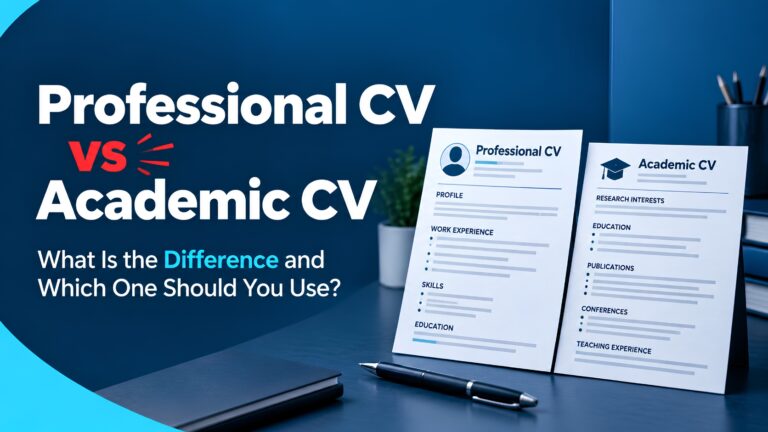
CV for Research and PhD Applications
An academic CV may include sections that would not normally appear on a standard professional CV, such as:
- research interests
- research experience
- publications
- conference presentations
- teaching experience
- academic awards
- technical or laboratory skills
Oxford specifically notes that a graduate CV may include qualifications, publications and other experience relevant to the application.
Keep the Design Professional
A CV does not need complex graphics to stand out.
Use:
- consistent headings
- readable fonts
- clear spacing;
- simple bullet points
- aligned dates
- consistent formatting
Europass recommends presenting skills and experience in a standardised, clear and transparent way and allows users to create multiple tailored versions. Avoid excessive colours, large icons, decorative charts or progress bars unless they genuinely suit the application.
Common CV Mistakes to Avoid
Watch out for:
- using one CV for every application
- including irrelevant experience in excessive detail
- spelling and grammar errors
- inconsistent dates
- vague descriptions
- exaggerating responsibilities
- adding skills you cannot demonstrate
- exceeding the stated page limit
- using an unprofessional email address
- confusing a CV with a motivation letter
Your CV should summarise your evidence. Your personal statement or motivation letter explains your reasons for applying.
Conclusion
Learning how to write a strong CV for scholarships, internships and global opportunities is mainly about relevance, clarity and evidence. You do not need to include everything you have ever done. Choose the education, experience, skills and achievements that best support your current application.
Keep a comprehensive master CV for your own records, then create a shorter tailored version for each opportunity. This approach is also reflected in Europass, which allows users to maintain a broad profile and generate different CVs for different applications. Most importantly, always follow the official programme instructions. A strong CV that ignores the required format, page limit or content guidance can still weaken an application.
Frequently Asked Questions
How long should a scholarship CV be?
There is no universal rule. Some programmes prefer one or two pages, while others allow three or more. Always follow the official application guidance.
Should I include a photo?
Only if the programme, employer or local convention requires it. It is not universally necessary.
Can I include volunteering in my CV?
Yes. Volunteering can be highly relevant, particularly for scholarships, leadership programmes and international opportunities.
What if I have no work experience?
Include relevant education, projects, volunteering, extracurricular activities, technical skills and academic achievements.
Should I use Europass?
Use it when the programme requests or accepts Europass, or when it suits your application. Europass is an official EU tool that allows you to create and tailor CVs free of charge.
Should I include references?
Only if requested. Otherwise, you can normally leave them out and provide referees separately when the application asks for them.
Should I include all certificates?
No. Include only certificates that are relevant and meaningful to the opportunity.
Can one CV work for scholarships and jobs?
A master CV can serve as your base, but the final version should be adapted. A scholarship CV may emphasise academics and leadership, while an employment CV may focus more heavily on skills and professional achievements.
Mindship Global Tip:
Keep one detailed master CV containing all your education, experience, projects, volunteering, achievements and skills. For each application, copy it and remove anything that does not strengthen your fit for that specific opportunity.
Disclaimer:
Mindship Global shares verified educational opportunities for informational purposes only. Always verify eligibility, funding, deadlines, required documents and application requirements through the official programme website before applying.