
Vatican Observatory Summer School 2027
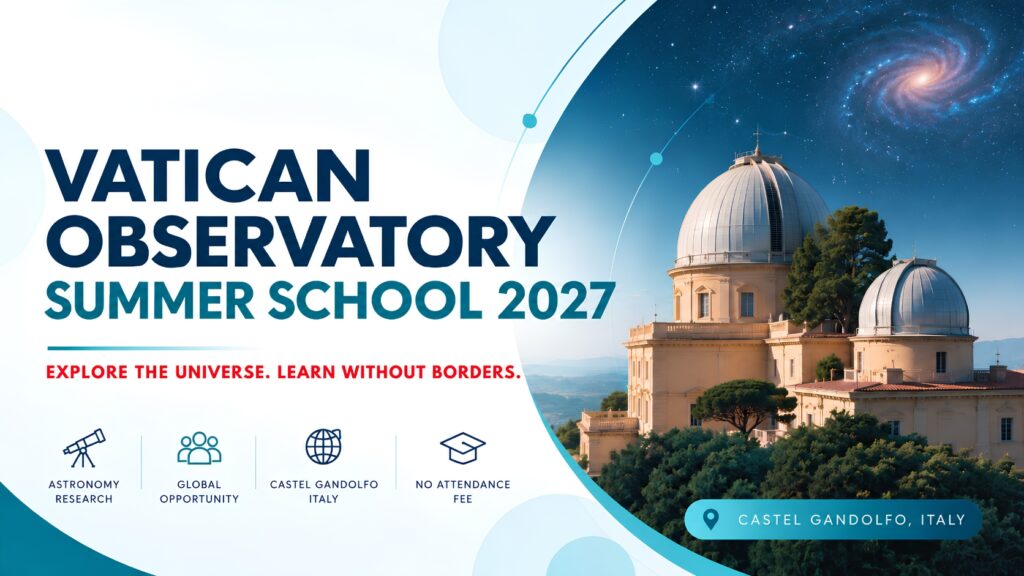
The Vatican Observatory Summer School 2027 is an intensive international astronomy programme in Castel Gandolfo, Italy, for advanced undergraduate and early postgraduate students. There is no required attendance fee, and students experiencing financial hardship may request support towards travel and housing costs.
Vatican Observatory Summer School 2027 in Italy – Astronomy Research Programme
Quick Overview
| Host Organisation | Vatican Observatory |
|---|---|
| Host Country | Italy |
| Location | Vatican Observatory Headquarters, Castel Gandolfo, Italy |
| Opportunity Type | International Astronomy Summer School / Research Programme |
| Programme Theme | Late Stages of Stellar Evolution |
| Degree/Academic Level | Final-year undergraduate to early postgraduate students |
| Field | Astronomy, Astrophysics and related fields |
| Funding Status | No required attendance fee; needs-based travel and housing support available |
| Duration | Approximately 4 weeks |
| Eligible Applicants | International students in astronomy-related fields |
| Nationality | Open internationally; maximum two selected students from any one country |
| Application Fee | Not specified; no required fee to attend the programme |
| IELTS/English Requirement | No IELTS or formal English-language test requirement stated; programme instruction is in English |
| Applications Open | Yes |
| Application Deadline | 30 September 2026 |
| Recommendation Letter Deadline | 14 October 2026 |
| Programme Period | June 2027; exact dates are not stated on the current 2027 programme page |
Detailed Description
The Vatican Observatory Summer School 2027 (VOSS 2027) is the 20th edition of the Vatican Observatory's long-running international astronomy summer school. The programme brings young astronomers from around the world to Castel Gandolfo, Italy, for an intensive period of academic study, research engagement and international collaboration. The Summer School programme has been running since 1986.
The 2027 academic theme is Late Stages of Stellar Evolution. Participants will explore how stars evolve through their later phases, including red giant and asymptotic giant stages, mass loss, planetary nebulae and white dwarfs, and how these processes contribute to the chemical evolution of galaxies.
The curriculum is particularly relevant at a time when facilities including the James Webb Space Telescope (JWST) and Nancy Grace Roman Space Telescope are opening new possibilities for studying evolved stars and stellar populations.
Main academic themes include stellar structure and evolution, dust production by evolved stars, stellar populations in clusters and galaxies, reconstruction of star-formation histories and observations using ground- and space-based facilities.
The faculty includes researchers from institutions such as the Vatican Observatory, INAF Observatory of Rome, University of Michigan, Space Telescope Science Institute, Macquarie University and INAF's Astrophysics and Space Science Observatory of Bologna.
Alongside the academic programme, participants can expect social and cultural activities. The exact 2027 extracurricular schedule has not yet been finalised; previous editions have included cultural excursions around Rome, sports, films and international cultural activities
Eligibility Criteria
- Applicants should be studying in an astronomy-related field.
- Students in the final year of undergraduate study may apply.
- Students in the early stages of postgraduate study may apply.
- This includes students preparing for or beginning a Master's, PhD or equivalent postgraduate programme.
- Applicants from countries worldwide may apply.
- Selection is based on the applicant's background, interest and ability.
- A maximum of two students from any one country will be selected.
- Religious faith is not part of the selection criteria.
- Students of all faiths, including those with no religious affiliation, may apply.
- Participants should be able to study and participate academically in English; however, no IELTS or other formal English-language test is specified.
Am I eligible?
Answer a few quick questions and see how your profile matches this opportunity.
Your answers stay in your browser. Nothing is sent to us.
Benefits
- No required programme attendance fee.
- Intensive approximately four-week astronomy and astrophysics programme.
- Teaching and academic interaction with international researchers specialising in stellar astrophysics.
- Training focused on the late stages of stellar evolution.
- Exposure to research involving stellar populations, nucleosynthesis, dust production, galaxy evolution and major astronomical facilities.
- International academic networking with students from multiple countries.
- Cultural and social activities alongside the academic programme.
- Students experiencing financial hardship may request financial support towards travel and housing costs.
- Access to the Vatican Observatory's academic environment in Castel Gandolfo.
Documents Required
The public VOSS 2027 page confirms:
- Completed online application through the official application portal.
- Letter(s) of recommendation submitted by the separate recommendation deadline.
- Information required within the official online application form.
- A financial-support request, where applicable, for applicants who need assistance with travel or housing.
Application Process
Review the Programme
Read the official VOSS 2027 page and make sure your academic stage and field match the programme. The school is intended for final-year undergraduate and early postgraduate students in astronomy-related disciplines.
Review the 2027 Research Theme
Consider how your academic background and research interests connect with Late Stages of Stellar Evolution and the programme's main themes.
Prepare Your Application
Gather the information and supporting material requested through the official Indico application system. If you require financial assistance, follow the programme instructions for requesting travel or housing support.
Submit Your Application
Complete and submit the official online application by 30 September 2026.
Arrange Your Recommendation
Ensure the required recommendation material is submitted by 14 October 2026, following the instructions provided through the application process.
Wait for the Selection Outcome
The Vatican Observatory reviews applications after the deadline. Its general Summer School information states that successful applicants are normally notified around mid-December.
Selection Criteria
The Vatican Observatory states that selection is based on:
- Applicant's academic and educational background.
- Applicant's interest in the programme and subject.
- Applicant's demonstrated ability.
- Suitability for advanced study in astronomy and astrophysics.
- Relevance of the applicant's academic stage to the programme.
- Geographic diversity, with a maximum of two participants selected from any one country.
Timeline
- Applications openOpen now
- Application deadline30 September 2026
- Recommendation letters deadline14 October 2026
- Selection reviewAfter the application deadline
- Results announcedTypically around mid-December according to the general VOSS guidance
- Programme beginsJune 2027
- Programme durationApproximately four weeks
Why This Opportunity?
- Study a specialised astrophysics topic through an intensive international programme.
- Learn from researchers based at leading astronomy institutions.
- Develop deeper knowledge of stellar evolution and stellar populations.
- Gain exposure to research connected with JWST, Roman and other major observing facilities.
- Build relationships with young astronomers from different countries.
- Experience an established programme that has operated since 1986.
- Explore postgraduate and research pathways in astronomy.
- Participate in an academically and culturally diverse international environment.
Mindship Global Tips
- Check your academic stageMake sure you will be in the final stage of undergraduate study or the early stage of postgraduate study when the programme takes place.
- Connect your interests to the themeExplain how your studies or research interests relate to stellar evolution, astrophysics or the scientific areas covered by VOSS 2027.
- Focus on academic evidenceSelection explicitly considers your background, interest and ability, so provide clear evidence rather than generic enthusiasm.
- Arrange your recommendation earlyYour referee has until 14 October 2026, but contacting them well before the deadline reduces the risk of delays.
- Request funding accuratelyIf you have financial hardship, use the official process to request travel and housing support rather than assuming that all costs will automatically be covered.
- Plan for visa processingThe organisers moved the deadline earlier specifically because international visa waiting times have increased.
- Use the official portalComplete your application only through the application system linked by the Vatican Observatory.
- Submit before the deadlineDo not leave your application until 30 September, particularly if you need clarification or supporting material.
Frequently Asked Questions
Is IELTS required?
No IELTS or other formal English-language test is listed as a VOSS 2027 requirement. The Vatican Observatory states in its Summer School guidance that the programme is taught in English.
Is there an application fee?
The official 2027 page does not state a separate application fee and confirms that there is no required fee to attend the school. Applicants should check the live application portal for any updated conditions.
Can international students apply?
Yes. The Summer School is designed for astronomy students from around the world. A maximum of two students may be selected from any single country.
Is VOSS 2027 fully funded?
Not automatically for every participant. There is no required attendance fee, and applicants experiencing financial hardship may apply for support towards travel and housing costs. The exact amount of support for the 2027 cycle is not publicly specified.
Can undergraduate students apply?
Yes. Students in the final year of their undergraduate studies in astronomy-related fields are eligible to apply.
Can Master's and PhD students apply?
Yes, provided they are in the early part of postgraduate study. The programme describes eligible students as those preparing for Master's, PhD or equivalent studies.
Do I have to be Catholic to apply?
No. Religious faith is not considered during selection, and the programme explicitly encourages students of all faiths to apply.
What subject will be studied in 2027?
The 2027 theme is Late Stages of Stellar Evolution, including stellar structure, evolved stars, dust production, stellar populations, galaxy star-formation histories and astronomical observations.
Where will the programme take place?
The Summer School will be held at the Vatican Observatory headquarters in Castel Gandolfo, Italy, near Rome.
What is the application deadline?
Applications must be submitted by 30 September 2026. Recommendation letters have a separate deadline of 14 October 2026.
How many students are selected?
The Vatican Observatory's general Summer School information describes VOSS as bringing together approximately 25 students, with no more than two selected from any individual country.
Official Application Link
Disclaimer
📌 Mindship Global shares verified educational opportunities for informational purposes only. Applicants should verify eligibility, funding arrangements, deadlines, required documents, and application requirements through the official website before applying.
Questions & Comments
No questions yet. If something about this opportunity is unclear, ask - the answer helps whoever reads it next.
Ask a question
Deadlines pass quickly - passing it on is often what gets someone to apply in time.