Interviews can feel unpredictable, but many difficult interview questions become easier when you understand what the interviewer is actually trying to assess. For students, graduates, researchers and young professionals, one of the most important questions to prepare is: “Tell me about yourself.”
Knowing how to answer Tell Me About Yourself can help you create a strong first impression and set the direction for the rest of the interview. Your answer should not be your entire life story or a line-by-line summary of your CV. Instead, it should give the interviewer a concise picture of your background, strengths, experience and motivation for the role.
The University of Cambridge Careers Service advises candidates to review the job description, identify how their skills and experience match the role, and prepare evidence for the competencies the interviewer is likely to assess.
Key Takeaways
- Keep your introduction relevant to the role rather than giving your full biography.
- Aim for roughly one to two minutes for “Tell me about yourself”.
- Connect your education, experience and skills to the opportunity.
- Prepare examples for strengths, weaknesses, challenges and achievements.
- Use evidence instead of simply saying you are hardworking, organised or a good communicator.
- For competency questions, structure examples clearly using Context, Action and Result.
- Practise aloud, but avoid memorising every sentence.
How to Answer Tell Me About Yourself
Understand What the Interviewer Wants
“Tell me about yourself” is often an opening interview question. It gives the interviewer an opportunity to understand your background while also assessing how clearly you communicate and how relevant your experience is to the role.
Prospects recommends focusing on your skills, characteristics and achievements, particularly those that make you suitable for the job description.
Your response should therefore answer three questions:
- Where have you come from professionally or academically?
- What are you doing or developing now?
- Why does this opportunity make sense as your next step?
Use a Past–Present–Future Structure
A simple structure can stop you from rambling.
- Past: Briefly explain your relevant education, experience or interests.
- Present: Describe what you are currently doing and highlight one or two relevant strengths.
- Future: Explain why you are interested in this particular role or organisation.
For example:
“I recently completed my degree in environmental science, where I developed strong research and analytical skills through my final-year project. Since graduating, I have also gained experience in digital communication and working with online audiences, which has strengthened my ability to communicate complex information clearly. I am now looking for a role where I can combine analytical thinking, communication and project work, which is why this position particularly interests me.”
The answer is focused, professional and gives the interviewer several areas to explore further.
How to Answer Other Difficult Interview Questions
What Is Your Biggest Weakness?
Choose a genuine but manageable weakness and explain what you are doing to improve it. Avoid answers that disguise a strength as a weakness, such as “I work too hard”.
A stronger response could be:
“I used to spend too much time refining written work because I wanted every detail to be perfect. I now use clear review stages and time limits, which helps me maintain quality while working more efficiently.”
The aim is to demonstrate self-awareness and development rather than pretend you have no weaknesses.
Why Should We Choose You?
Do not try to prove that you are “better” than every other candidate. Instead, demonstrate why your experience matches the role.
You could say:
“My academic work has developed my analytical and research skills, while my customer-facing experience has strengthened my communication and problem-solving. This role requires both, and I can provide practical examples of using those skills successfully.”
Before your interview, identify two or three important requirements from the job description and prepare evidence showing how you meet them.
Tell Me About a Challenge or Failure
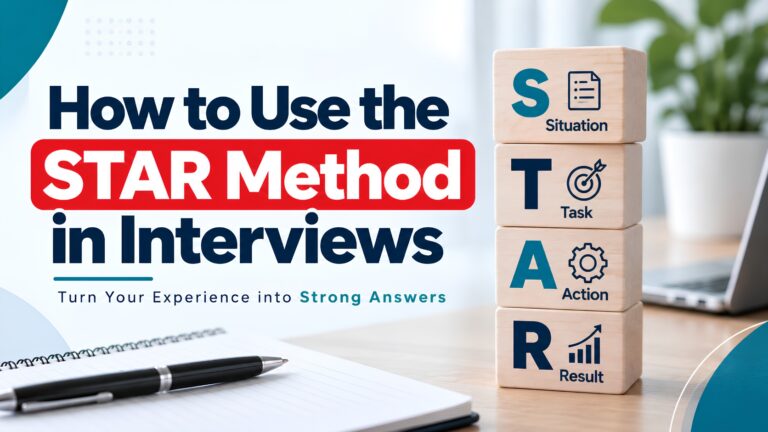
Behavioural interview questions often ask for a real example. Cambridge Careers recommends the CAR structure: Context, Action and Results.
- Context: Briefly describe the situation or problem.
- Action: Explain exactly what you did.
- Result: Describe the outcome and what you learned.
Keep most of the answer focused on your own contribution rather than spending too long describing the problem. A difficult outcome is not automatically a bad interview example. If something did not go perfectly, show what you learned and how your approach changed afterwards.
Why Do You Want This Role?
Avoid answers such as “It is a great company” or “I need experience”.
A strong answer connects:
- what the organisation does
- what the role involves and
- why your experience or career direction fits.
For example:
“I am interested in this role because it combines research, stakeholder communication and project coordination. I have developed these skills through university projects and part-time work, and I am particularly interested in applying them within an international organisation.”
How to Prepare for Difficult Interview Questions
Research the Role Carefully
Do more than read the organisation’s homepage.
Review:
- the job description
- required competencies
- recent organisational activity
- the team or department
- key responsibilities and
- the organisation’s values and objectives.
Cambridge Careers notes that interviewers frequently work from a list of qualities or competencies and ask questions designed to obtain evidence of them.
Build an Evidence Bank
Prepare four to six examples from your:
- university studies
- research
- employment
- internships
- volunteering
- societies
- personal projects or
- extracurricular activities.
Try to cover teamwork, leadership, problem-solving, communication, initiative, dealing with pressure and learning from mistakes. The same example can sometimes answer several different interview questions if you adjust the emphasis.
Practise Out Loud
Reading answers silently is different from saying them naturally.
Practising aloud helps you notice whether your answer is too long, repetitive or unclear. Cambridge Careers recommends practising interview responses because becoming comfortable talking about your experience can make the real interview feel more natural.
Common Interview Mistakes to Avoid
- Giving a five-minute autobiography when introducing yourself.
- Repeating your CV word for word.
- Making claims without evidence.
- Memorising answers so closely that they sound scripted.
- Criticising a previous employer, university or colleague.
- Giving identical answers to every organisation.
- Talking about the team when the interviewer wants to know what you did.
- Answering the question you prepared rather than the question actually asked.
Frequently Asked Questions
How long should “Tell me about yourself” be?
Around one to two minutes is usually enough. Your goal is to provide a clear professional overview, not cover every part of your background.
What if I have very little work experience?
Use examples from university assignments, research projects, volunteering, societies, internships, part-time work or independent projects. Skills can be demonstrated in many settings.
Should I mention personal interests?
You can briefly mention them when relevant or when they add personality, but your main focus should normally remain on education, experience, skills and motivation.
Should I memorise interview answers?
Prepare the structure and key points rather than memorising every sentence. A flexible answer usually sounds more natural.
What if I do not understand an interview question?
Ask politely for clarification. Cambridge Careers notes that asking for clarification when necessary can demonstrate confidence and communication skills.
Conclusion
Learning how to answer Tell Me About Yourself gives you a strong foundation for the rest of an interview. Keep your introduction concise, relevant and connected to the opportunity.
For other difficult interview questions, prepare evidence rather than perfect scripts. Understand your experience, identify what the employer is assessing and practise explaining your examples clearly.
Strong interview preparation is less about predicting every possible question and more about knowing your own experience well enough to adapt confidently.
Mindship Global Tip
Before your next interview, prepare six strong examples from your study, work, research or volunteering. Practise turning each one into a short Context–Action–Result answer so you have flexible evidence available for different questions.
Disclaimer
Mindship Global shares verified educational opportunities for informational purposes only. Always verify eligibility, funding, deadlines, required documents and application requirements through the official programme website before applying.