Reaching the interview stage of a scholarship or fellowship is an important milestone. Your written application has already attracted the attention of the selection panel; the interview is your opportunity to bring that application to life.
Strong scholarship interview preparation is not about memorising perfect answers. It is about understanding the programme, knowing your own application, preparing evidence from your experiences and being able to explain clearly why the opportunity fits your future plans.
Interview formats and assessment criteria vary between programmes. For example, Chevening uses a competency-based panel interview and discusses applicants’ experience, aspirations and course choices, while Schwarzman Scholars describes its interview as a free-flowing conversation driven partly by the written application. Rhodes interviews can be wide-ranging, exploring academic ability, character, leadership, commitments and aspirations.
The most effective approach, therefore, is to prepare thoroughly without sounding rehearsed.
Key Takeaways
- Research the programme’s mission and official selection criteria before preparing answers.
- Review every important part of your original application.
- Prepare specific examples of leadership, teamwork, resilience, initiative and impact.
- Use the STAR method to structure evidence-based answers.
- Be ready to explain why you chose the programme and what you will contribute.
- Develop clear short-, medium- and long-term goals.
- Practise responding to follow-up and unexpected questions.
- Complete realistic mock interviews without memorising scripts.
- Always check the official programme’s own interview instructions.
1. Understand What the Programme Is Actually Looking For
Your first step should be understanding what the scholarship or fellowship exists to achieve.
Different programmes assess different qualities. Chevening, for example, places importance on areas including leadership, relationship building, course choices and career planning. The Rhodes Scholarship considers academic excellence alongside character, service, extracurricular achievement and leadership.
Read Beyond the Eligibility Criteria
Do not stop after reading the basic requirements. Explore the programme’s mission, selection criteria, applicant guidance and information about previous participants.
Ask yourself: What qualities does this programme value? What kind of impact does it expect scholars or fellows to make? Which experiences from my own background demonstrate those qualities?
This helps you move away from generic answers and towards responses that are relevant to the specific programme.
2. Review Your Original Application
Your application is one of your most important interview preparation resources.
Read your personal statement, motivation letter, CV, essays, research proposal and any examples of leadership or professional experience you submitted. Interviewers may ask you to expand on something you wrote months earlier.
Schwarzman Scholars specifically advises shortlisted applicants to be ready to discuss their application in detail, including their essays and experiences, while Chevening also tells candidates to prepare to discuss examples included in their written application.
If you wrote that you led a project supporting 300 students, for example, be ready to explain your personal role, the challenge you were addressing, what you actually did, what changed and what you learnt.
3. Build an Evidence Bank
Instead of trying to predict every possible scholarship interview question, prepare six to ten strong experiences that you know well.
Choose examples that can demonstrate qualities such as leadership, teamwork, problem-solving, communication, resilience, initiative, community engagement, innovation or learning from failure.
One experience may support several questions. Organising a student conference, for example, could demonstrate leadership because you coordinated a team, stakeholder engagement because you worked with speakers and partners, and problem-solving because you managed unexpected changes.
Having an evidence bank gives you flexibility without forcing you to memorise complete answers.
4. Use the STAR Method Naturally
The STAR method can help you give clear, evidence-based responses.
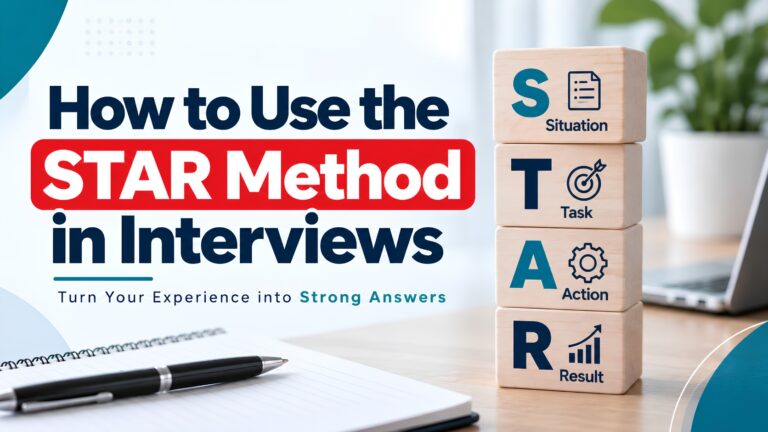
STAR stands for Situation, Task, Action and Result. The UK National Careers Service recommends it as a way of structuring interview examples while keeping them concise and conversational.
Focus on What You Actually Did
Briefly explain the situation and your responsibility, but spend more time describing your actions and results.
If asked about leadership, do not simply say, “I am a strong leader.” Explain what the situation was, what decision you made, how you influenced others and what happened as a result.
Where appropriate, add reflection: what did you learn, and what would you do differently now?
5. Prepare for “Why This Scholarship or Fellowship?”
This is one of the most important questions to think about before your interview.
Your answer should go beyond funding, prestige, rankings or the opportunity to travel. Explain why this particular programme makes sense for your development.
A useful structure is:
Past experience → Current need → Programme → Future impact
Show how your existing experience has led you to this point, what skills or knowledge you still need, how the programme can help and what you intend to do with that experience afterwards.
Chevening’s official guidance similarly encourages candidates to connect their chosen study with their background, career aspirations and intended future impact.
6. Know What You Will Contribute
Scholarships and fellowships are rarely interested only in what you will receive. Panels may also want to understand what you will bring to the programme.
Think about your professional experience, academic knowledge, cultural perspective, networks, practical skills and community involvement.
Contribution Is More Than Participation
Saying that you will “work hard” or “attend all activities” is unlikely to differentiate you.
Instead, explain how you could contribute to peer learning, discussions, collaborative projects, alumni activities or the wider programme community. Chevening’s interview guidance specifically encourages applicants to think about their distinctive strengths and how those strengths could benefit the wider network.
7. Develop a Credible Career Plan
Interviewers may want to understand what happens after the scholarship or fellowship.
Think about your short-term goals after completing the programme, where you realistically want to be within three to five years and the broader contribution you hope to make over the longer term.
Avoid vague statements such as wanting to “change the world”. Explain what you want to change, who you want to work with and how you plan to make progress.
Chevening advises candidates to develop specific short-, medium- and long-term career plans and clearly demonstrate how the programme fits those ambitions.
8. Prepare for Questions About Challenges and Failure
A good interview will not necessarily focus only on your successes.
You may be asked about a failure, a difficult decision, disagreement, setback or situation where your original approach did not work.
These questions can reveal self-awareness and your capacity to learn. Choose a genuine example, explain your responsibility and show what changed afterwards.
You do not need to turn every failure into a dramatic success story. Thoughtful reflection is often more credible than trying to make every experience sound perfect.
9. Expect Follow-Up and Unexpected Questions
Memorised answers become particularly risky when interviewers start asking follow-up questions.
If you say that you persuaded senior colleagues to support a project, you might then be asked why they initially disagreed, what evidence you used or what you would have done if they had rejected your proposal.
Some programmes may also move beyond your written application. Schwarzman Scholars, for example, states that its conversations can develop into new topics and currently includes a question relating to current news events during the interview.
Know your experiences well enough to discuss them naturally from several angles.
10. Practise Without Over-Rehearsing
Mock interviews are one of the most practical ways to improve your scholarship interview preparation.
Ask a lecturer, mentor, manager, colleague or trusted friend to read your application and conduct a realistic interview. Ask them to challenge your answers rather than simply working through a predictable list of questions.
Both Rhodes guidance for academic advisers and Schwarzman Scholars encourage interview practice or mock interviews as part of preparation. Schwarzman also specifically advises candidates not to memorise anticipated answers.
Record yourself if useful and review whether your answers are clear, focused and supported by evidence. Practise enough to become comfortable with your story, but leave room for a genuine conversation.
Frequently Asked Questions About Scholarship Interviews
What questions are commonly asked in a scholarship interview?
Questions vary by programme, but common themes include your motivation, leadership experience, academic or professional background, course or programme choice, career plans, challenges you have faced and what you would contribute if selected. Always use the official programme guidance as your primary reference.
How long should scholarship interview answers be?
There is no universal answer length. Focus on answering the actual question clearly rather than speaking for a predetermined amount of time. Straightforward questions may require brief answers, while competency-based questions may need more detail and evidence.
Should I memorise scholarship interview answers?
Generally, no. Prepare your experiences, key points and evidence instead. Memorised scripts can sound unnatural and may make it harder to respond to follow-up questions.
What should I do the day before a scholarship interview?
Check the official interview instructions, confirm the time and format, prepare any required identification or documents, test your technology if the interview is online and review your key examples. Programme-specific requirements vary, so always follow the instructions in your invitation.
Conclusion
Effective scholarship interview preparation combines programme research with a strong understanding of your own experiences. Know what the programme values, review your application, prepare evidence, practise structured answers and be clear about your future direction.
You do not need to predict every question. Instead, prepare well enough to explain your experiences, decisions, ambitions and contributions naturally.
The interview is ultimately an opportunity for the selection panel to understand the person behind the written application. Clear evidence, thoughtful reflection and programme-specific preparation will help you present that person accurately and confidently.
Mindship Global Tip:
Before your interview, create a one-page preparation sheet containing the programme’s key selection criteria, five strong examples from your experience and your short-, medium- and long-term goals. Use it for preparation, but do not rely on a script during the actual interview.
Disclaimer:
Mindship Global shares verified educational opportunities for informational purposes only. Always verify eligibility, funding, deadlines, required documents and application requirements through the official programme website before applying.